



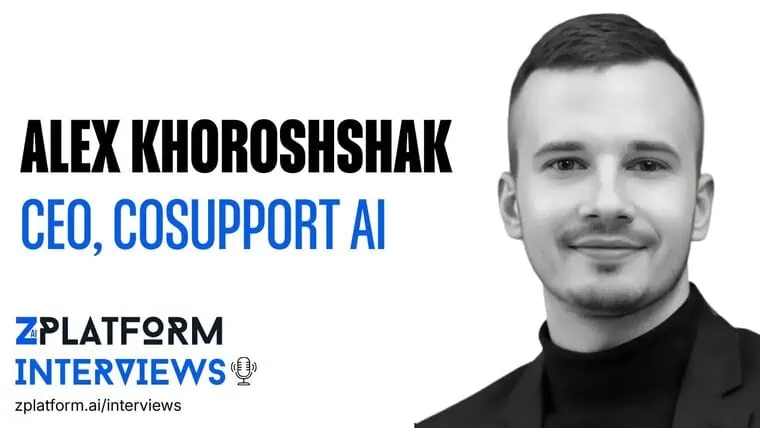
Most AI support tools promise the same thing: deflect more tickets, cut costs, scale without hiring. CoSupport AI promises something harder to fake - answers that are correct and traceable to a source document, with a 30-day pilot on real tickets (the first 1,000 AI responses free) so teams can check that before they pay.
That promise rests on a USPTO-approved architecture built to stop the one failure mode that quietly kills AI support deployments: confident, wrong answers. We sat down with CEO Alex Khoroshchak to unpack the technology behind the claim, the real numbers from customer deployments, how the pricing actually works, and why he believes the support inbox is the most underused data source in the company.
Company & background
When did CoSupport AI start, who founded it, and what was the original mission?
In 2020, Daria Leshchenko had spent more than a decade running support operations, and every tool on the market gave her the same result: generic bots, slow replies, no memory of the customer. So she founded CoSupport AI to build the product she couldn’t buy. 3 years of R&D and hundreds of tests later, that product drafts ready-to-send replies for support teams.
CoSupport AI is a SupportYourApp company. In 2024, Alex Khoroshchak joined as CEO, leading the platform’s evolution into AI customer support software for SaaS and ecommerce teams with a high ticket volume. The company is headquartered in the US and serves 300+ brands globally, from SaaS companies and ecommerce platforms to fintech firms and education providers. The mission has stayed consistent since day one: build AI that resolves support tickets accurately using a company’s own data, not generic training sets.
What problem in customer support did you originally set out to solve, and how has that vision evolved?
In 2020, the tools that existed were not solving the problem; they were superficial. The vision from day one was to build AI that goes beyond basic automation - something genuinely intelligent, helpful, and human-like. The first product was an AI assistant that generated ready-to-use reply suggestions for support agents. That was the starting point.
In 2023, the team set a bigger mission: build AI solutions that deliver immediate, measurable business results while setting a new standard for customer service. By 2025, under Alex Khoroshchak’s leadership, CoSupport AI had grown from that single support tool into two products: the AI Agent for autonomous ticket resolution and the AI Assistant for agents, both with multilingual support in 120+ languages. Version 2.0, released on June 15, 2026, added multi-step reasoning, decision logs, and an agentic API. The goal has not changed: make AI not just a tool in the support stack, but a trusted partner that handles the work intelligently and turns every customer interaction into actionable insight.
Who is your ideal customer today?
CoSupport AI fits companies with medium to high ticket volume, where a significant share of incoming requests are repetitive and well-documented. Specifically:
- Industries: SaaS, ecommerce, fintech, education, BPO, and contact centers
- Support team size: 5 to 500+ agents
- Ticket volume: 500 to 100,000+ tickets per month
- Tech stack: teams using Zendesk, Freshdesk, Intercom, Zoho, HubSpot, or Salesforce Service Cloud
The fit is strongest when three conditions are present: high repetitive ticket volume, an existing helpdesk with historical ticket data, and a support leader who measures success by resolution quality and cost, not just deflection rate.
Product & capabilities
Walk me through the core products in the suite.
CoSupport AI has exactly two products:
- CoSupport AI Agent - fully autonomous. Handles incoming requests end to end across email, chat, and helpdesk channels. Trained on the company’s own tickets, knowledge base, and internal documentation. Clients average 74% AI resolution on the 1.x architecture, and up to 85% on 2.0. Priced at $0.50 per AI resolution, with unresolved tickets free and no seats needed.
- CoSupport AI Assistant (Copilot) - agent-facing. Sits inside the helpdesk and drafts suggested replies using full conversation context. Agents review, edit, and send. Built-in translation and ticket summarization cut ticket-handling time by 40 to 60% on tickets the AI does not resolve. Priced at $0.04 per AI response.
Multilingual support is a capability inside both products, not a separate product: the AI detects the customer’s language and responds in it, in 120+ languages. Teams can also ask the AI questions about their support operations, products, and customers from Slack or Microsoft Teams.
Which channels does the AI support today?
CoSupport AI operates across email, chat, and helpdesk ticketing. The AI Agent runs natively inside Zendesk, Freshdesk + Freshchat, Zoho Desk + SalesIQ, Intercom, Salesforce, Slack, Microsoft Teams, Shopify, Stripe, HubSpot, and Pylon. Action connectors let it take actions in 2,000+ apps, and a custom API connects in-house systems such as custom CRMs or legacy tools. Shopify has two deploy modes: a standalone chat widget with no helpdesk, or on top of your helpdesk. The most commonly deployed combination is email plus chat plus helpdesk, typically Zendesk or Freshdesk.
How does the AI handle multilingual conversations, and how many languages are supported?
Multilingual support is built into both the AI Agent and the AI Assistant and covers 120+ languages. Language detection is automatic: the system identifies the customer’s language from the incoming message, retrieves the relevant answer from the knowledge base (which can be in any language), and generates the response in the customer’s language. A single AI instance handles every locale without separate training per language or separate routing by language. That is especially valuable for BPOs and global ecommerce operations serving multi-regional customers.
What does a typical onboarding and go-live timeline look like?
CoSupport AI connects in minutes, and most teams are fully live in about 3 days:
- About 10 minutes: connect the helpdesk and data sources.
- Days 1 to 3: the AI learns from the company’s tickets, help center content, web content, and internal docs, while accuracy is tuned, confidence thresholds are calibrated, and escalation logic is tested against real ticket patterns.
- Around day 3: fully live - the AI handles real tickets and performance tracking begins immediately.
Client requirements are minimal: access to historical ticket data, helpdesk credentials for the integration, and a knowledge base or documentation source. No engineering involvement is required for standard helpdesk integrations. Custom integrations with proprietary helpdesks or CRMs typically take 30 days.
Technology & differentiation
Your site mentions a USPTO-approved AI architecture. What does the patent cover, and why does it matter?
The patent covers the architecture that controls how AI responses are generated. In practice it enforces three things that separate it from generic LLM deployments:
- Knowledge grounding: the AI generates responses only from a defined, verified set of company data sources - tickets, help center articles, internal documentation, product data. It cannot draw on its general training data or fabricate information outside those boundaries.
- Controlled generation: output logic is deterministic within defined parameters. The system does not produce open-ended responses; it retrieves and synthesizes from approved sources.
- Confidence thresholds with mandatory escalation: when certainty falls below a defined threshold, the system escalates to a human agent with full context rather than producing a low-confidence answer. This is enforced at the architecture level, not through prompt engineering.
Why it matters: hallucination is the primary trust failure in AI support. A customer who gets a confident but incorrect answer about a refund policy, account status, or product spec loses trust faster than they would over a slow reply. The patent addresses that structurally, not through workarounds.
How is CoSupport AI different from solutions built on generic LLMs?
CoSupport AI uses a hybrid architecture that combines proprietary retrieval and generation controls with underlying large language models. The key distinction is in what the model is allowed to access and say. Generic LLM tools generate responses from broad training data; they may be accurate for general questions but frequently hallucinate on company-specific policies, pricing, product details, and account information. With CoSupport AI, responses are generated exclusively from the company’s own verified data. The LLM handles language understanding and generation; the patented retrieval and control layer determines what it can access and when it must stop.
The platform is not fine-tuned on a single model. It uses retrieval-augmented generation (RAG) with a proprietary control layer that enforces knowledge boundaries, which produces more consistent accuracy than fine-tuning generic models, particularly in compliance-sensitive environments.
What are the top USPs you would highlight to a prospect?
- Patented AI architecture: responses from verified data only, every answer traceable to a source document. Each draft is validated against the client’s sources before it is sent, which is how we reach 99% response accuracy.
- Low-risk start: a 30-day pilot on real tickets, with the first 1,000 AI responses free.
- Unified platform: autonomous resolution, agent copilot, multilingual support, and conversation analytics in one place - no per-module billing, no extra vendors, no integration maintenance overhead.
- Fast deployment, no engineering required: standard helpdesk integrations connect in about 10 minutes and are fully live in about 3 days, with no code and no rip-and-replace of existing infrastructure.
- Outcome-linked pricing: no per-agent seats. The AI Agent costs $0.50 per AI resolution and unresolved tickets are free; the AI Assistant costs $0.04 per AI response.
How do you handle data security, privacy, and compliance?
- ISO 27001 certified
- GDPR and CCPA compliant
- Data anonymization and encryption - AES-256 at rest, TLS in transit
- Role-based access controls and audit logs on all interactions
- Dedicated server options for customers requiring full data isolation
- No data sharing with third parties, and no use of customer data for model training outside the client’s own environment
For regulated industries such as fintech, healthcare, and legal, dedicated infrastructure deployment is offered as a standard option, not an enterprise add-on.
Performance & results
What KPIs do customers typically see improve, and what is realistic in the first 3 to 6 months?
Based on documented customer deployments:
- AI resolution rate: an average of 74% across clients on the 1.x architecture, and up to 85% on the 2.0 architecture. For repetitive Level 1 requests the deflection ceiling is 90%; that is a deflection figure, not a resolution rate.
- Response accuracy: 99%, because each draft is validated against the client’s sources before it is sent.
- First response time: from hours to seconds. Average AI response time is 1.5 seconds, and human-queue response times typically fall 40 to 70% as volume is redistributed.
- Cost per ticket: typically drops from $3 to $15 (human-handled, fully loaded) to $0.50 per AI resolution, and unresolved tickets are not charged.
- CSAT: maintained or improved in well-configured deployments. The risk to CSAT comes from poor escalation design, not from automation itself.
- Agent handle time: 40 to 60% reduction on tickets handled with AI Assistant in copilot mode.
Can you share a few detailed customer case studies?
Cocoatech (SaaS, Zendesk). 81% of chats resolved by AI.
ProjectFitter (AI-driven hiring platform, Freshdesk + Freshchat). ProjectFitter first tried to build its own AI support model on OpenAI’s API, but integrating it with Freshdesk and Freshchat proved too resource-intensive, and training on historical tickets produced inconsistent responses from outdated information. With CoSupport AI on Freshdesk and Freshchat, the result was 75% of chats resolved by AI and 93% faster chat resolution.
Softorino (software development). Softorino evaluated six AI vendors but found that competing solutions frequently hallucinated, producing outputs they could not trust for support, marketing, or HR. They needed accuracy across three departments - Customer Support (Zendesk), Marketing, and HR. CoSupport AI integrated the AI Assistant with Zendesk and connected the AI to Slack for marketing and HR questions. The result: AI resolution grew from 69% to 82% in three months.
‘Setup took one API key. In three months, resolution rates grew from 69 to 82 percent. We tested six other tools before. Nothing performed as well as CoSupport AI.’ - Bogdan Dzhel, CEO, Softorino
Our own support operation. CoSupport AI is a SupportYourApp company, and we run it on SupportYourApp’s internal support: 80% of internal support requests are resolved by AI, saving $14,000 a month.
Other results: Shelterluv reached 73% of chats resolved by AI by month three, and 61% of emails; Hour Timesheet reached 82% of chats resolved by AI by month three; eCatering has 50% of email tickets resolved by AI; and Outstaff Your Team went live in 3 days, with 58% faster first response.
Market & competition
Who do you consider your main competitors, and where does CoSupport AI win or lose?
The landscape splits into three categories:
- Native helpdesk AI (Zendesk AI, Freshdesk Freddy AI): built into the helpdesk UI with no separate vendor contract for teams already on those platforms. In practice, though, Zendesk Advanced AI is an expensive add-on on top of an already costly subscription. CoSupport AI wins on accuracy - the patented architecture is specifically designed to prevent hallucinations, a documented weakness in generic add-ons - and for teams running multiple helpdesks or wanting to avoid dependence on one platform’s AI roadmap.
- Purpose-built AI support platforms (Ada, Forethought, Decagon, Sierra): these vary in architecture, pricing, and target segment, and several skew mid-market to enterprise with longer implementations and higher entry prices. CoSupport AI wins on pricing structure (pay per AI resolution, no seats) and a pilot on real tickets that lets teams verify results before they pay.
- General-purpose AI repurposed for support (ChatGPT integrations, custom LLM wrappers): low barrier to entry, but two compounding problems - the engineering effort to integrate and maintain them is substantial, and hallucination rates without a grounded architecture create real accuracy and compliance risk. CoSupport AI wins on accuracy, integration simplicity, and enterprise readiness.
What are the most common reasons prospects choose CoSupport AI over another vendor?
- A real test before paying: prospects burned by a previous AI deployment respond strongly to a 30-day pilot on their own tickets, with the first 1,000 AI responses free.
- Deployment speed: connecting in about 10 minutes and being fully live in about 3 days is consistently faster than alternative enterprise platforms.
- Pricing model: $0.50 per AI resolution, with unresolved tickets free and no seats, is more economical than per-seat models for teams with high AI resolution rates. For example, 5,000 tickets a month at 70% AI resolution is 3,500 x $0.50 = $1,750 a month, versus $3,465 with Intercom Fin at $0.99 per outcome.
- Accuracy through grounded architecture: regulated industries and teams with previous hallucination incidents choose CoSupport AI specifically for patent-backed knowledge boundary enforcement.
- Unified platform: teams managing separate tools for translation, analytics, and automation consolidate and reduce overhead.
Pricing & commercials
How does your pricing work?
Pricing is tied to what the AI actually does, not to agent seat count. There is one price per product:
- CoSupport AI Agent: $0.50 per AI resolution. Unresolved tickets are free, and no seats are needed.
- CoSupport AI Assistant: $0.04 per AI response.
Every new customer starts with a 30-day pilot on real tickets, with the first 1,000 AI responses free. There are no setup fees and no long-term contract requirement on entry.
Support, roadmap & company direction
What does post-sale support look like?
- A dedicated implementation team for the first 30 days covering setup, training, data preparation, integration, shadow mode, and go-live.
- A customer success manager assigned to each account after go-live, responsible for performance review, optimization recommendations, and scope expansion.
- An SLA of 4 business hours for standard accounts and 1 business hour for enterprise, with a dedicated Slack channel for enterprise and BPO accounts.
- Training resources - documentation, onboarding guides, and knowledge base content at go-live, plus ongoing access to the support team for configuration questions.
What is on the product roadmap for the next 6 to 12 months?
While specific release timelines are not disclosed publicly, the directional priorities include:
- Proactive AI: moving from reactive resolution to proactive engagement - AI that identifies high-risk accounts from support signals and reaches out before a cancellation request arrives.
- Deeper conversation analytics: structured feedback loops from conversation analytics directly into product team workflows, with configurable alerts when signal thresholds are crossed.
- Expanded voice capabilities: building on current voice deployment for BPOs with more sophisticated intent classification and resolution.
- More helpdesk integrations: expanding the native integration library based on customer demand.
- Model accuracy improvements: continuous refinement of confidence calibration to reduce false escalations while maintaining zero-hallucination standards.
Any recent milestones to highlight, and what is the long-term vision?
Recent milestones include the release of version 2.0 on June 15, 2026, with multi-step reasoning, decision logs, and an agentic API, growth to 300+ brands served, the USPTO patent granted for CoSupport AI’s core architecture, ISO 27001 certification enabling deployment in enterprise and regulated environments, live deployments across BPO, SaaS, ecommerce, fintech, and education verticals in multiple countries, recognition on G2, Capterra, and Crozdesk as a top performer in AI customer support, and AWS partner recognition.
As for the long term: CoSupport AI is building toward a world where support is not a cost center but an intelligence layer. The goal is not just to resolve tickets autonomously, but to make every customer interaction a source of structured business intelligence that feeds product, sales, and operations decisions in real time. The support conversation is one of the richest data sources a company has, and most organizations are not using it. CoSupport AI is building the infrastructure to change that.
More Founder Interviews
Tuikor AI founder and CEO Musk Mah on why Tuikor is a digital human social platform rather than an AI companion app, what its 1M+ personalities...

DeltaReview founder Rida Rahim on why her AI code reviewer has no login, why she refuses GitHub integration, and the weak output she flagged herself.

ConvertMyStore founder Thiago Nobre on outgrowing a $29 Shopify scan, refusing magic scores and guarantees, and what he will not let AI decide.