

The short version: a free gut check, not evidence
| Field | Detail |
|---|---|
| Tool | AIscan24 |
| Category | Free browser-based AI content detector that reports an AI-Similarity percentage, not a probability that a machine wrote the text |
| Best use case | A fast second opinion on whether your own draft still reads like machine output |
| Price | Free tier: yes, and it is the only tier. No signup, no email, no credit counter, no word cap. Minimum input 80 words. No paid plan exists. Checked 31 July 2026. |
| Test result | Caught pure ChatGPT text at 100%, but scored a paragraph I wrote by hand at 80% (ZeroGPT: 37.5%). No highlighting, report or API. |
| Verdict | Use it as a free gut check, never as evidence that a person used AI |
Disclosure: Free-tier tested. AIscan24 is free with no account, so this review is based on my own test runs on July 31, 2026. No vendor access, no payment, no affiliate link. I cross-checked three of the five samples against ZeroGPT, which is run by an unrelated company.
What is AIscan24?
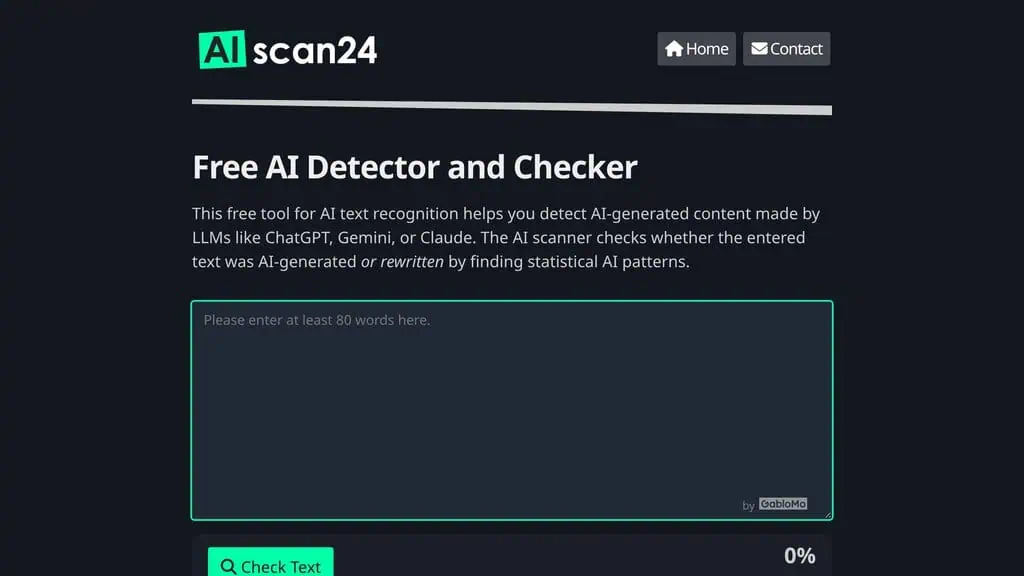
AIscan24 is a free, browser-based AI content detector that estimates how closely your text matches the statistical patterns of large language model output. You paste at least 80 words into one box, press Check Text, and get a percentage labeled AI-Similarity. There is no account, no upload and no file support.
It is built by GabloMo.com, a small German company, and there is a German-language version of the same tool at kidetektiv.de. The same company also builds the humanizer AI-Text-Humanizer.com and the free writing toolbox Textbuddy, a conflict that gets its own section below. The tool shows a “Last Update” date, which read July 2, 2026 when I tested, a sign the model behind the score is being maintained rather than abandoned.
What the AI-Similarity number measures
It looks for the fingerprints of machine writing rather than any hidden marker or watermark. The vendor describes it as checking writing patterns, repetitions, and filler words that characterize LLM output, plus the specific phrases and formatting habits that models overuse and humans rarely do.
So a high score doesn’t mean a model wrote your text. It means your text is written the way models write. Polished, evenly structured, cliche-friendly prose scores high whether a human or a machine produced it. The mechanics are covered in our guide on how AI detectors actually work, and it is the single most useful thing to understand before you act on any score.
On privacy, the vendor states that inputs are not stored, not shared with third parties, and not used to train any model, and that text is evaluated on a German server then deleted immediately, with encryption in transit. That is a strong stated position, though as with any hosted tool you are trusting a policy rather than auditing it.
The score bands, and what I would do at each
The tool publishes its own interpretation guide, which I appreciate, because a bare percentage invites people to invent their own thresholds.
| Score | AIscan24 label | What I would actually do |
|---|---|---|
| Below 33% | Rather human | Nothing. Move on. |
| Around 50% | Rewritten or mixed | Ask about process, not authorship |
| Above 66% | Rather generated | Investigate with real evidence, never accuse |
Notice the hedging in the vendor’s own words: “rather human,” “rather generated.” Not “human” and “AI.” That word choice is accuracy, and it is why I trust this tool more than one that shows me a confident 97% with a red banner.
How accurate is AIscan24? My five-sample test
Here is the full test, run in one session on July 31, 2026, with every sample between 130 and 180 words. I cross-checked three of them on ZeroGPT.
| Sample | What it actually is | AIscan24 | ZeroGPT |
|---|---|---|---|
| 1. ChatGPT cliche paragraph | 100% machine written | 100% | 100% |
| 2. My published review paragraph | 100% written by me | 80% | 37.5% |
| 3. My conversational writing | 100% written by me | 25% | not tested |
| 4. Output of a paid humanizer | Machine text, rewritten once | 3% | 0% |
| 5. Output of a free humanizer | Machine text, rewritten once | 17% | not tested |
Four of five results are defensible. One is a false positive on my own work, and the pattern between samples 2 and 3 is the most useful finding in this review.
Test 1: it catches obvious AI instantly
I wrote 132 words of the worst business writing imaginable: “in today’s rapidly evolving digital landscape,” “leverage cutting-edge artificial intelligence solutions,” “unlock their full potential,” “paradigm shift,” “holistic approach to digital transformation.” Every phrase on the list of AI giveaway words I keep for exactly this purpose, and nothing a person would say out loud.
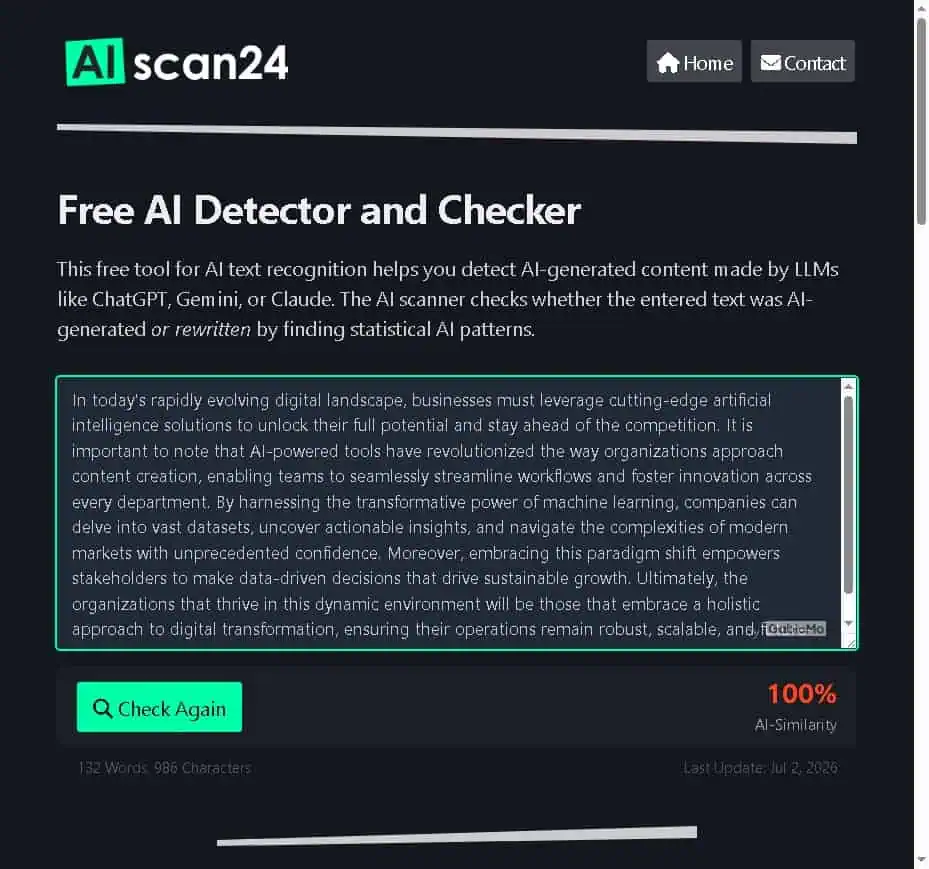
Result: 100% AI-Similarity, returned in roughly two seconds. ZeroGPT agreed at 100%. The speed is a real advantage over detectors that make you wait behind a queue.
Test 2: the false positive that should change how you use this
Then I pasted 138 words from a review I wrote myself, the opening of my Morningscore write-up, which had been sitting on my site for months. It describes my skepticism about gamified SEO tools, mentions testing over four years, and states that pretty interfaces mean nothing to me if the numbers are off. Human, first person, opinionated, and written before I ever used an AI tool for drafting.
Result: 80% AI-Similarity, above the detector’s own “rather generated” threshold of 66%. The same paragraph on ZeroGPT scored 37.5%, with the verdict “Your Text is Most Likely Human written, may include parts generated by AI/GPT.”
Both detectors were wrong to some degree, and AIscan24 was wrong by more. If a teacher had scored a student’s genuine essay that way, or a client a freelancer’s real draft, somebody’s reputation takes a hit over a statistic that’s simply wrong.
Test 3: the pattern behind it
I pasted a different sample of my own writing, this time in my spoken register: a story about finding two forgotten email subscriptions on my own bank statement, and the $300 I burned on scam sites as a teenager before earning my first $15 online.
Result: 25% AI-Similarity, comfortably in the “rather human” band. Same author, same session, same word count within a few words, and the score dropped from 80% to 25%.
The difference is polish, not authorship. Sample 2 was edited prose written for publication: tight, balanced sentences, careful structure, clean transitions. Sample 3 was conversational: numbers thrown in mid-sentence, a slightly rambling clause, concrete personal detail that no model would invent. These tools reward mess and punish craft. The better an editor you are, the more likely your own writing gets flagged.
Tests 4 and 5: humanizer output slips right through
I ran the same ChatGPT paragraph from Test 1 through two rewriting tools and rescanned the output.
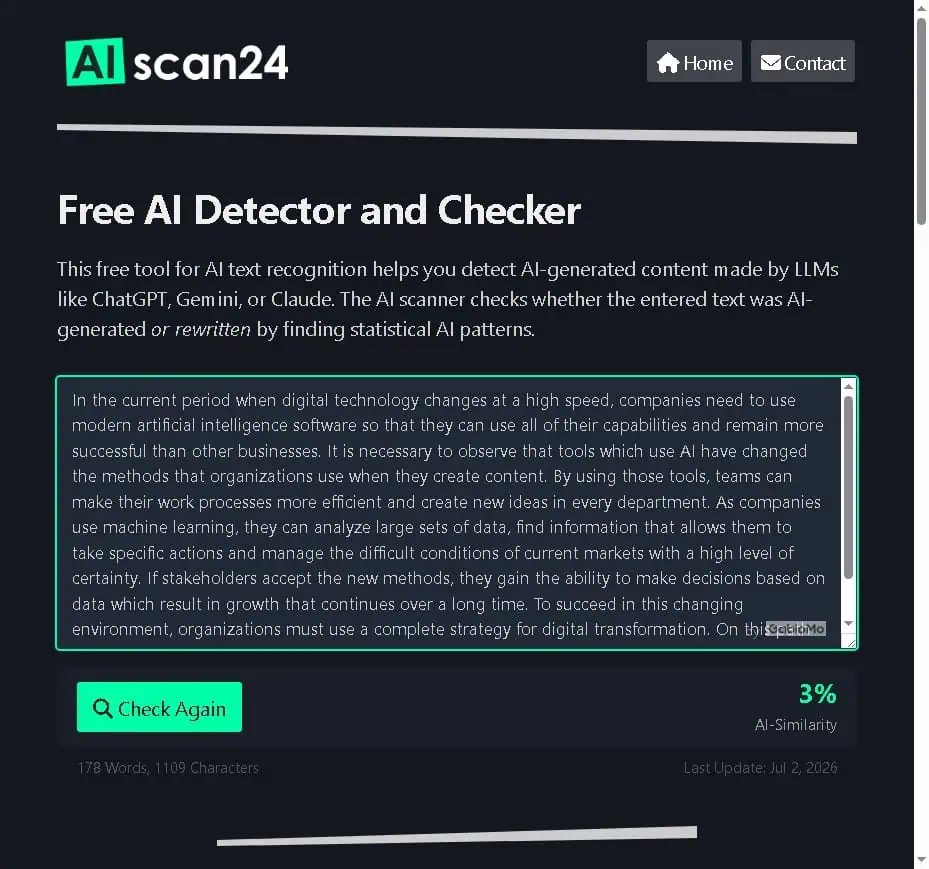
The paid tool, AI-Text-Humanizer.com, took it from 100% to 3% here and 0% on ZeroGPT. The free Textbuddy humanizer took it to 17%. One pass each, no manual editing, no clever prompting.
So the honest scoreboard for anyone hoping to use detection as enforcement: machine text that nobody bothered to rewrite gets caught, and machine text that went through 10 seconds of rewriting does not. I broke down both rewrites, including what the output reads like, in my AI-Text-Humanizer.com review and my Textbuddy review.
Why detectors misread human writing
Because they measure style, and human style overlaps with machine style far more than the marketing admits. AIscan24 says this itself: there is by design a very large overlap between human and robot language.
The published research backs that up harder than any single test of mine could. A Stanford study published in Patterns found that GPT detectors are biased against non-native English writers, misclassifying more than half of the TOEFL essays it tested as AI generated, while classifying essays by native-speaking students almost perfectly. The mechanism matches what I saw in my own two samples: simpler, more uniform sentence construction reads as machine-like to a classifier.
OpenAI retired its AI text classifier in July 2023, citing a low rate of accuracy: the company that builds the model could not reliably detect the model. Even Turnitin, which sells detection to institutions at scale, has publicly acknowledged a false positive rate of around 4% at the sentence level and adjusted its reporting thresholds because of it. Four percent sounds tiny until you multiply it by every sentence in every essay in a semester.
Against that backdrop, AIscan24 refusing to claim certainty is the most defensible thing about it. Its FAQ states plainly that clear proof of AI use is not possible and that detectors are not legally binding.
What AIscan24 cannot do
- Tell you which paragraphs drove the score. You get one number for the whole text, with no sentence-level highlighting. That is exactly what you need when text mixes human writing and AI assistance, and mixed text is now the normal case.
- Take a file. It is a text box only, so checking 30 student submissions means copying and pasting 30 times, where competing tools accept DOCX and PDF.
- Give you anything to attach to a case. No exportable report, nothing timestamped, nothing to show a student or a client. For any formal process, that alone rules it out.
- Plug into a workflow. There is no API and no history, so you cannot integrate it into editorial tooling or look up what you scanned last week.
- Tell you how accurate it is. I could not find published precision or recall numbers, or any description of the test set behind the model. Most competitors publish accuracy claims that do not survive contact with an independent test, so a missing number is arguably better than a misleading one.
- Handle second-language writing safely. The interface is English, the German version lives at kidetektiv.de, and no other languages are listed. Given the research on non-native English writers and this tool’s harshness on polished prose, I would not trust a score on text written in a second language.
- Catch deliberate evasion. Humanized text scored 3% and 17%, so anyone rewriting to avoid detection will not be caught.
The conflict of interest nobody should ignore
AIscan24’s own FAQ warns you about sites that flag everything as AI and then sell you a tool to bypass detection. Its exact advice: better avoid these sites. The same company sells a humanizer designed to bypass detection.
I’m not going to pretend that’s fine because I like the detector. The vendor operates both the scanner and the tool that defeats scanners, and it points to its own detector as “the best AI detector” in the humanizer’s FAQ while pointing to its own humanizer from the detector’s footer.
In practice I saw no evidence of the specific abuse the FAQ warns about. The detector did not inflate scores to sell rewrites: it scored my conversational writing at 25% and cleared it, when a predatory tool would have flagged it and offered a fix. My handwritten 80% was harsher than ZeroGPT, but the humanizer output scored 3%, meaning the detector was generous to the sister product rather than hostile to me. Still, treat scores from any detector that shares ownership with a humanizer as one data point among several, and never make a decision about a person based on a single tool’s percentage.
Who should open AIscan24, and who should not
It suits writers and editors who want a fast second opinion with no account and no counter running down, and anyone publishing AI-assisted content: scan before, edit, scan after is a useful loop for checking whether your editing pass removed the patterns. For a gut check on a few hundred words it is the fastest option I used, and the German server and no-training policy suit privacy-conscious users.
It does not suit teachers building a case, anyone scanning second-language writing, institutional or formal processes that need a report, or bulk workflows. As a private prompt for a conversation about process it is fine. As the basis of an accusation it is not.
How to use AIscan24 responsibly
If you scan other people’s writing, this section is the reason I wrote the review.
- Use it as a screening question, never as a verdict. A high score means “this reads like machine writing,” which is worth a conversation. It does not mean “this person cheated,” and no detector can support that claim.
- Ask for process, not confessions. Document history in Google Docs or Word shows how a piece was written over time. AIscan24’s own FAQ recommends exactly this. Version history is a record; a score is a guess.
- Score a known-human control first. Before you scan anyone else, run three paragraphs you personally watched being written. It takes four minutes. My own writing scored 80% and 25% in the same session, and until you have seen that variance on text you can vouch for, you will overweight the number.
- Be extra careful with non-native English writers. If your student or your writer works in a second language, the tool is measuring their fluency as much as anything else.
- Never combine a score with a punishment. Not a grade, not a payment dispute, not a contract termination. If you would not act on it in front of an appeals board, do not act on it at all.
- If your own draft scores high, fix the writing: real numbers, real examples, your actual opinion, a sentence only you could write. That improves the piece and lowers the score at the same time.
AIscan24 vs ZeroGPT, GPTZero and Copyleaks
| Detector | Cost | Signup | What it gives you | Main limitation |
|---|---|---|---|---|
| AIscan24 | Free | None | Fast AI-Similarity score, honest bands, EU processing | No uploads, no highlighting, no report |
| ZeroGPT | Free tier with character limit | Optional | Score plus a verdict sentence, file upload on paid tiers | Upsell-heavy interface, paid tiers for volume |
| GPTZero | Free tier | Account for most features | Sentence highlighting, reports, integrations | Real functionality sits behind a paid plan |
| Copyleaks | Paid, trial available | Yes | Enterprise reports, LMS integrations | Cost, and confident scoring on uncertain data |
Switch to ZeroGPT when you want a second independent reading, which is how this review’s results were cross-checked; to GPTZero when you need sentence highlighting and reports rather than a single number; and to Copyleaks when you need enterprise reports and LMS integrations and can accept confident scoring on uncertain data.
AIscan24 wins on speed, zero friction, no cap, and the most honest framing of what a score means. It loses on anything institutional: if you need a document you can defend in a meeting, you need highlighting and exportable reports, and that means a paid tool with the same accuracy problems and a nicer PDF. Our roundup of the best AI detectors compares that side of the market in detail.
Yes as a gut check, no as evidence
My test did not change my view that this is a good free tool: it never inflated a score to sell me a rewrite, and it cleared my conversational writing when a predatory tool would have flagged it. It changed where I would let anyone use it. The most useful thing I took from the test was not a verdict on one tool but watching my own writing score 80% and 25% in the same ten minutes. Detectors don’t measure who wrote something. They measure how polished it reads.
So open it first for a quick paragraph check, factor in the shared ownership with a humanizer, and never let its number stand alone against a person.
Next step: to see how easily these scores are defeated, read my AI-Text-Humanizer.com review, where one rewrite pass took a 100% score to 0% on an independent detector. For the free alternative from the same company, I tested all 17 tools in the Textbuddy review. And if you want honest verdicts on AI tools before you spend money, that is what the whole reviews section is for.
Related Posts

I tested AgainstData on 355 pages of Gmail data. Bulk unsubscribe, personal data deletion requests, pricing, and whether...
AI-Text-Humanizer.com took a 132-word ChatGPT paragraph from 100% AI to 0% on ZeroGPT but flattens your voice. Buy the $...
Honest Aithenticate review after hands-on testing. Does this AI disclosure badge tool meet EU AI Act requirements? Prici...
My hands-on Answer Socrates review covering all features, free plan limits, pricing, and how it compares to AlsoAsked. I...

I’ve spent $4,200 on 118 AppSumo lifetime deals over 5 years. Here’s my honest review: what works, what fails, and wheth...
I checked Aura++’s DR 69 backlink claim in Ahrefs (it’s really 71) and broke down every launch tier. Here is whether the...