

Verdict: Buy
AppSumo: free to browse, $99 a year for Plus
| Field | Detail |
|---|---|
| Tool | AppSumo, an Austin-based marketplace founded by Noah Kagan in 2010 |
| Category | Lifetime software deal marketplace for early-stage SaaS: vendors sell one-time licences instead of subscriptions |
| Best use case | Cutting recurring SaaS costs by buying one-time licences for tools that solve a problem you have today |
| Price | Free to browse and buy. Deals typically run $49 to $299 per licence tier. AppSumo Plus membership is $99 per year. |
| Refunds | 60 days, any reason, on every purchase |
| The real risk | Vendor failure, not fraud: roughly 15% of tools shut down within three to four years |
| Verdict | Worth using if you apply a hard filter to every deal, expensive if you buy on impulse |
Is AppSumo legit? Yes, and the risk sits with the vendor
AppSumo is a legitimate company with a 16-year track record, a real refund policy and a community of millions of buyers. When people search “is AppSumo legit” they usually mean “will I get ripped off if I buy here?”, and the platform itself will not rip you off. Purchases process cleanly and support responds. I have used the refund process five times across my 118 purchases, and every refund landed back on my card in 3 to 5 business days without argument.
The risk is vendor failure. When you buy a lifetime deal, you are betting that the company selling it will still exist in 3 years. AppSumo vets its vendors and requires a working product before listing, but early-stage startups fail at high rates regardless of how good the launch looked. From my own purchase history:
- 60% of tools are still actively running and useful
- 20% were replaced by better workflows or superior tools
- 15% shut down with no recovery
- 5% were refunded within the 60-day window
That 15% shutdown rate sounds alarming until you do the math. If you spend $99 on a tool and it saves you $30/month for 2 years before shutting down, you made $621 in savings on a $99 investment. The deal still worked even though the company did not survive.
What AppSumo sells: 50 to 80 deals, most gone within 8 weeks
AppSumo is a software deal marketplace where early-stage SaaS companies offer lifetime licences at heavily discounted prices in exchange for a large volume of customers and public exposure. The name combines “App” with Noah Kagan’s broader “Sumo” brand, which also includes tools like KingSumo and TidyCal. Unlike a coupon site, these are not discounted monthly subscriptions: they are one-time payments for permanent access, so if the tool survives and scales you have locked in access at a fraction of what later users pay.
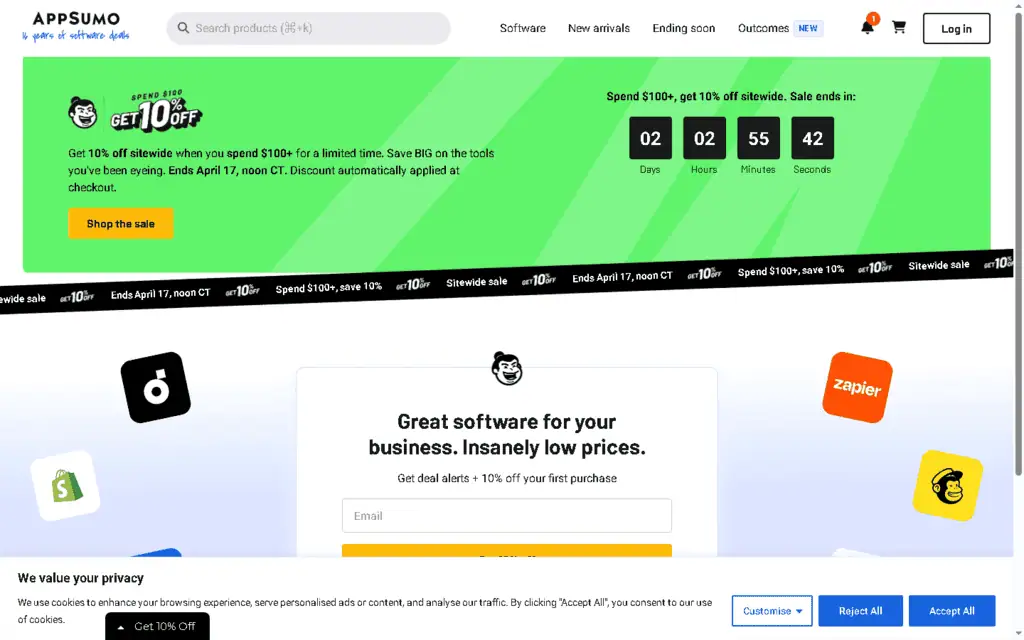
The trade is demand for cash: a startup gets a surge of paying customers, public reviews and immediate cash flow, and buyers get permanent access. AppSumo keeps roughly 70% of deal revenue and the vendor takes about 30% plus the users and reviews, which is why deals skew toward products with broad appeal rather than deep niches. AppSumo also earns from Plus memberships, its own Originals and referral commissions.
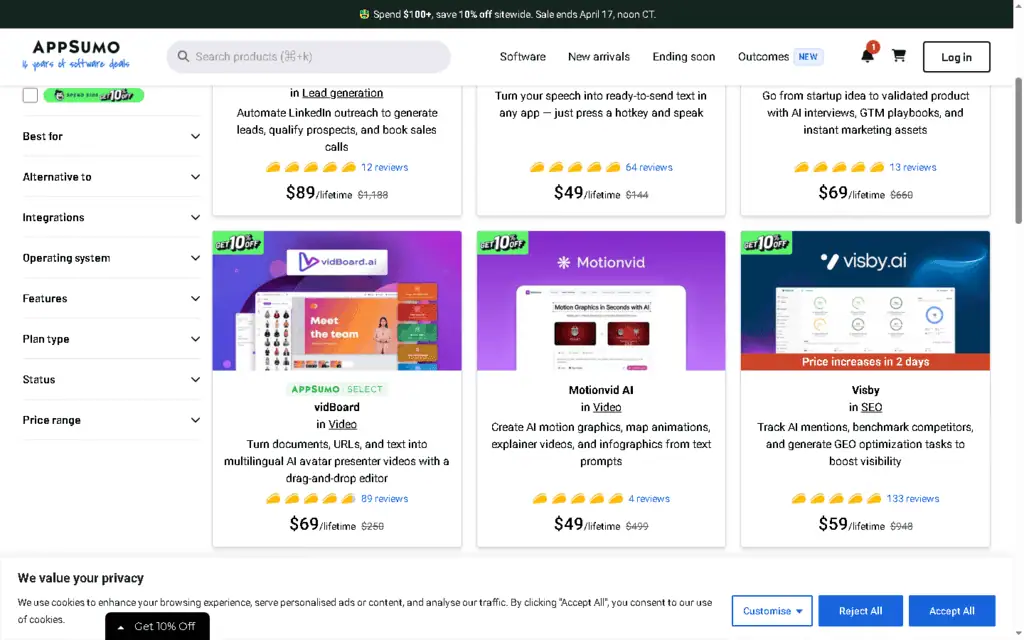
At any given time AppSumo runs 50 to 80 active deals across AI tools, marketing automation, productivity, project management, WordPress plugins, analytics and video. New deals launch weekly and most run 4 to 8 weeks before closing permanently, so outside a sale there is no benefit to waiting once you have decided a deal fits. You redeem the code with the vendor directly, and the licence lives in your vendor account, not in AppSumo.
Tiers and code stacking: where first-time buyers overpay
A standard AppSumo deal offers three to five licence tiers. The entry tier, typically labeled Tier 1 or License Tier 1, covers basic usage limits. Higher tiers add more seats, higher usage caps, additional features, or agency-level access.
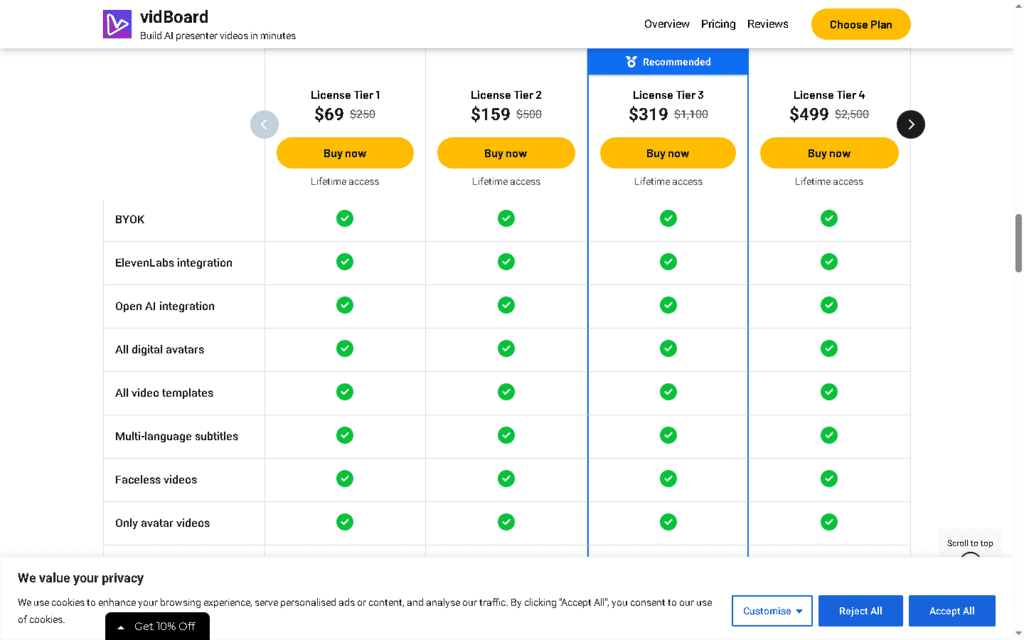
Across my 118 deals, 41% were Tier 1 at $49 to $69, 19% Tier 2 at $99 to $149, 22% Tier 3 at $199 to $249, and 18% Tier 4 or above at $299 and up.
The most common mistake I see is buying the cheapest tier to “test” the tool, then upgrading later at full Tier 2 or Tier 3 price once you need more capacity. Some deals let you stack codes instead: buying 2 codes at $69 each ($138 total) might give you the same limits as Tier 2 at $149 sold separately. That is how the tiered deal in our Pabbly Connect review works. Others block stacking entirely, and two deals with identical pricing tables can have opposite rules, because the rule sits in the deal terms rather than the pricing table. Stacking has saved me $200 to $300 over the years compared to buying higher tiers outright; getting it wrong is not refundable after 60 days.
The 60-day refund, and what happens when a vendor dies
The standard policy gives you 60 days from purchase to request a full refund, for any reason, back to the original payment method in 3 to 5 business days. It works even after you have activated the deal with the vendor, so you are not penalized for trying a tool for 59 days and deciding it does not fit.
- Log into your AppSumo account
- Go to “My Deals” and find the purchase
- Click “Get Support” or use the refund request link
- Select the reason (any reason is accepted)
- Wait 3 to 5 business days
After 60 days, the only protection is the Select badge. If a Select-badge tool shuts down within 12 months of purchase, Plus members receive a 100% refund credit and non-members receive 50%. Buy a $149 Select tool that shuts down eight months later and Plus returns the full $149 as credit to spend on another deal, while a non-member gets $74.50. A single recovery at that price covers more than a year of the $99 membership, which is the main argument for holding Plus before buying anything above $99.
AppSumo Plus pays for itself somewhere between $500 and $1,000 a year
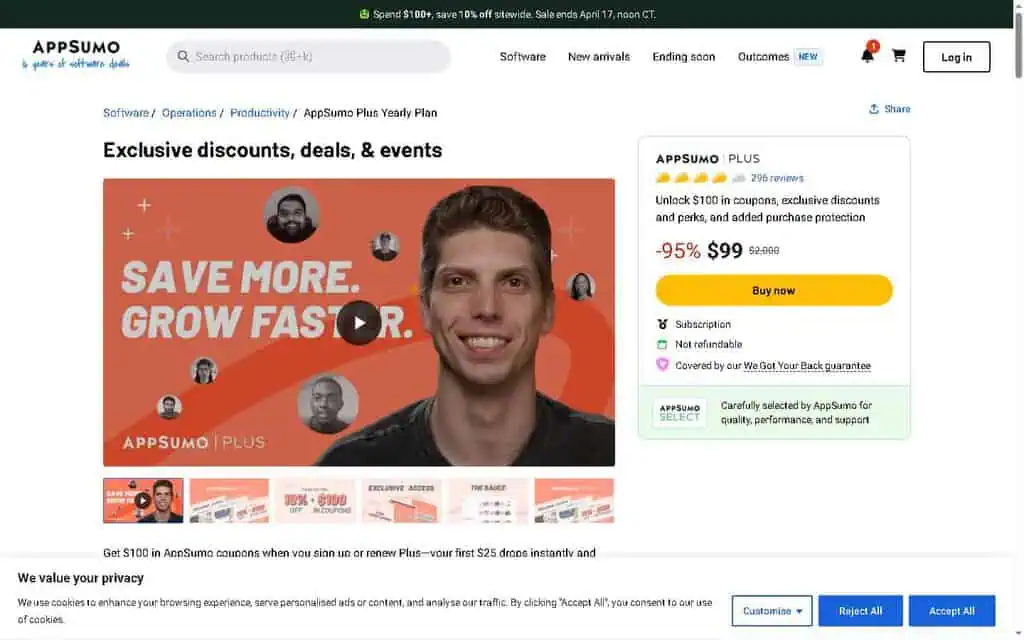
AppSumo Plus is a paid membership at $99 per year. It includes:
- 10% discount on every AppSumo order
- $100 in quarterly coupons delivered as $25 every 90 days
- 1-year purchase protection on deals with the “Select” badge (100% refund if the vendor shuts down within 12 months)
- Free KingSumo and SendFox Tier 1 access (tools built by AppSumo itself)
- Early access to new deals before they go public
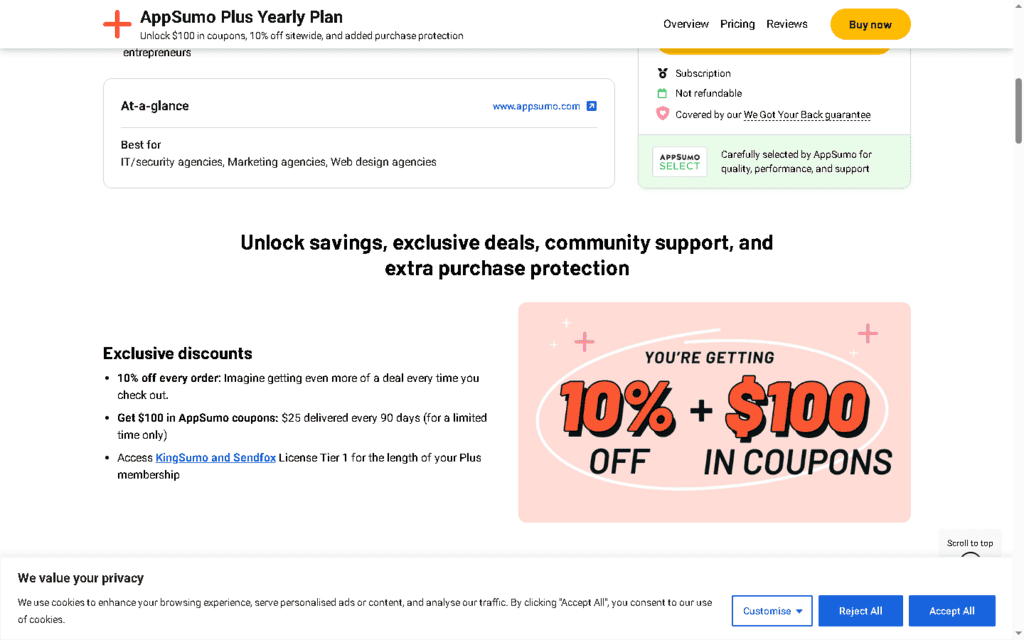
At $1,000 or more a year on deals, the 10% discount alone covers the fee, and with the $100 in coupons Plus effectively costs nothing. From about $500 a year it is usually still worth it, helped by the fact that new members get their first coupon immediately, so a $25 coupon stacks with the 10% discount on the first purchase. At one or two deals a year the math does not work.
The benefit I value most is the Select badge protection. On a higher-ticket deal ($199+) from a vendor I am unsure about, buying while that deal carries the Select badge gives me a safety net non-members do not have.
Which deal categories survive, from 118 purchases
Strong survival rates (75 to 85%)
Content and marketing utilities perform well: email outreach, content scheduling, lead generation and writing assistance. One example is the email verifier in our Reoon review. These tools solve specific, evergreen problems and tend to have sustainable business models at small scale.
WordPress plugins and themes are among the safest purchases, with low operational costs, predictable revenue from new licences and long shelf lives. I have never had a WordPress plugin deal shut down on me. Simple productivity and project management tools survive well because the simpler the product, the cheaper it is to maintain. Agency white-label solutions suit consultants, since the vendor has a focused audience willing to pay recurring agency fees after the lifetime deal closes.
Higher failure rates
Live video and webinar platforms carry the highest shutdown risk, because servers, bandwidth and ongoing development often outpace what lifetime revenue covers. Two of my live video purchases shut down within 18 months. “Zapier killer” automation platforms are technically demanding and expensive to maintain, and the graveyard of failed ones is large.
Generic AI wrappers are the current high-risk category, and deal quality has drifted toward them and toward first-time founders in 2025-2026. A tool that wraps an existing AI API in a chat interface has almost no defensible moat, and when the underlying API changes pricing or capabilities the wrapper often fails to adapt. I estimate roughly 30% of generic AI wrapper deals on AppSumo will not survive two years. Crypto and Web3 tools I do not buy on AppSumo at all.
AppSumo Originals: KingSumo, SendFox and TidyCal
AppSumo Originals are tools built and owned directly by AppSumo rather than third-party vendors. KingSumo (viral giveaways), SendFox (email marketing) and TidyCal (scheduling) are the primary ones. They carry lower shutdown risk because AppSumo controls the product, but they tend to have fewer features than dedicated alternatives in each category. Plus includes KingSumo and SendFox at Tier 1.
My filter before buying any AppSumo deal
The first question is always the same: “Does this solve a real problem I have right now, with a specific workflow I can describe in one sentence?” If the answer is vague or hypothetical, I skip it. After that, these are the signals I check.
Green flags
- The founder has a public presence of 12 or more months. Search the founder’s name and LinkedIn; a consistent public presence means accountability to the community.
- The product has 1,000 or more existing paying customers. Subscription revenue gives it a survival path that does not depend on lifetime deal cash. This is the single strongest indicator of long-term viability.
- Import and export exist, so you can get your data out if the tool fails.
- Reviews show 4.5 stars from 50 or more reviewers. A 4.5-star average from 150 reviews is meaningful validation.
- An active roadmap: public changelogs, recent update notes and a community forum. Tools with no visible development after launch drift into abandonment.
Red flags
- Zero public presence from the founder or team. I have skipped multiple deals because I could not find a single LinkedIn profile or public statement from the people behind the product.
- The company is less than 6 months old. It has not had time to find product-market fit, and lifetime revenue can mask that for a while.
- No data export capability. Non-negotiable.
- 4.8+ stars with fewer than 20 reviews, which usually means reviews from the founder’s network rather than real users.
- “AI-powered” as the sole differentiator. A tool that exists only because it wraps GPT-4 is building on rented land, and when OpenAI changes pricing or capabilities its value proposition can collapse.
Black Friday on AppSumo: the first 48 hours decide it
AppSumo runs meaningful Black Friday promotions each year: typically a sitewide discount stacked on individual deal prices, plus a small number of Black Friday exclusive deals that do not appear the rest of the year. Across several seasons, the best deals went live in the first 48 hours, and high-quality deals with limited codes sold out quickly, leaving the lower-demand ones.
Plus members get early access, so activating Plus before the sale starts, then stacking early access, the 10% discount and Black Friday pricing, gives the best deal window of the year. A tool that drops from $49 to $39 is still only a good deal if it passes the same filter. For current tracking, the ZPlatform Black Friday AI deals page separates genuine savings from cosmetic discounts.
Where the lifetime deal model costs you money
- Lifetime does not mean lifetime. Roughly 15% of tools shut down permanently within three to four years, so budget for the loss rather than assuming the licence outlives the vendor.
- The cheap test tier backfires. Upgrade paths often charge full Tier 2 or Tier 3 price later, and when stacking is blocked the cheap entry costs more than buying correctly once.
- The 70/30 revenue split shapes what you see. AppSumo earns on volume, so deal selection favours products with wide appeal over narrow tools that might serve you better.
- Email volume is heavy. Expect 5 to 10 emails a week and plan on filtering.
- The Select badge is the difference between 100% and 50% credit on a dead vendor, and it is not prominent at checkout.
- Some tools have no export path at all, which you have to check deal by deal.
- Support is functional, not exceptional. Refunds process cleanly, but anything more complex takes persistence.
Dealify, SaaSMantra or JoinSecret instead
| Alternative | Price | Pick it instead when |
|---|---|---|
| Dealify | Free to browse, one-time deal pricing | You prefer a smaller curated list of tools that already have product-market fit over AppSumo’s volume |
| SaaSMantra | Free to browse, one-time deal pricing, often below AppSumo entry prices | Budget is the deciding factor and you are willing to do your own vendor vetting |
| JoinSecret | Membership-based access to startup discounts | You want ongoing discounts on established SaaS rather than lifetime licences on early-stage tools |
AppSumo remains the largest and most reviewed of these, so it is the right starting point; the alternatives matter when it does not currently carry the category you need. For curated picks with Buy, Wait and Skip verdicts, see the AI lifetime deals hub.
Bootstrappers and agencies yes, enterprises no
AppSumo suits:
- Bootstrapped founders and solopreneurs spending $300 or more per month on SaaS, where systematic lifetime buying moves the cost line.
- Freelancers and agency owners, for whom one-time purchases are easier to justify against client work than per-seat fees.
- Content creators and marketers buying productivity and analytics tooling that is not business-critical.
- Small business owners on a fixed budget who treat purchases as three-year bets rather than permanent infrastructure.
AppSumo does not suit: enterprises needing SLAs, compliance certifications and vendor contracts, which deals rarely include; anyone who cannot tolerate tools changing, breaking or disappearing, because vendor risk is the model rather than a defect in it; impulse buyers, since the countdown timers and limited-code messaging work; and buyers of one or two deals a year, for whom neither Plus nor the evaluation time pays off.
My verdict after 118 deals and $4,200
I have bought 118 AppSumo deals since 2020 and spent roughly $4,200, which I estimate has saved $14,000 to $17,000 against equivalent monthly subscriptions. The distribution behind that total matters more than the total. My first purchase was a $49 keyword research tool I was 80% sure would fail within a year; it is still running and has saved more than $600. Against it sit deals that looked solid on paper and were abandoned inside 18 months. That is the model working as intended: the failures are affordable and the survivors pay for them many times over, but only if you treat purchases as a portfolio of bets rather than a discount store. Many of the winners appear in our best AI tools roundups.
If I were starting out again:
- Read the 3-star reviews first. Not the 5-stars, which come from excited early adopters, and not the 1-stars, which often come from people with technical setup issues. The 3-star reviews describe the honest limitations.
- Check the founder’s LinkedIn before buying anything over $99.
- Join the AppSumo community Q&A for any deal you’re considering. Ask a specific question about a use case relevant to your work. How the founder responds, or whether they respond at all, tells you more than the marketing copy.
- Budget for 15-20% loss. If you spend $500 on deals and $75 to $100 worth of those tools eventually shut down, that’s not a failure. That’s the expected cost of the model.
My rating: 4.2 out of 5 for active buyers who apply a filter. Not recommended for impulse buyers or enterprise users.
Disclosure: Some links in this article are affiliate links. I track both referral and non-referral options where available so you can choose whether to support ZPlatform at no additional cost to you.
Related Posts

I tested AgainstData on 355 pages of Gmail data. Bulk unsubscribe, personal data deletion requests, pricing, and whether...
AI-Text-Humanizer.com took a 132-word ChatGPT paragraph from 100% AI to 0% on ZeroGPT but flattens your voice. Buy the $...
AIscan24 is a free, no-signup AI detector: it caught pure ChatGPT text at 100% but scored my handwritten paragraph 80%. ...
Honest Aithenticate review after hands-on testing. Does this AI disclosure badge tool meet EU AI Act requirements? Prici...

My hands-on Answer Socrates review covering all features, free plan limits, pricing, and how it compares to AlsoAsked. I...
I checked Aura++’s DR 69 backlink claim in Ahrefs (it’s really 71) and broke down every launch tier. Here is whether the...