

Mindtrip is the best AI travel planner for most people in 2026, with Wanderboat and Layla next, and GuideGeek, Wonderplan or Google Travel if you want free. Below are 19 planners ranked by real organic traffic, re-measured this September. One thing up front: these build itineraries but do not book, so you confirm the flights and hotels yourself.
I have watched the “AI travel planner” space go from a novelty to a genuinely useful category, and also fill up with thin clones that promise the moon and hand you a generic listicle of tourist traps. So I did what most roundups skip: I ranked these by real monthly organic traffic from Ahrefs (a hard signal of who people use), pulled pricing from the official sites, and tested the planning workflow on each.
You will get a dedicated section for every tool, free versus paid clarity, the honest limitations, and clear guidance on the best AI for travel planning depending on what you need, written in the same hands-on style as our AI tool reviews. If you only have a minute, jump to the quick-pick table or free vs paid.
Key takeaways - Best overall: Mindtrip, the most-used dedicated AI trip planner, combines chat, maps, a live itinerary, and booking links in one place. - Best free: GuideGeek (free, in WhatsApp), Wonderplan, and Google Travel cover most needs at zero cost. - AI travel planner is not an AI travel agent. These tools plan and inspire brilliantly; they do not reliably book. Treat output as a smart first draft and verify the details. - Ranked by real traffic, not votes. Order reflects Ahrefs organic traffic, so it shows genuine adoption. - Two giants get a caveat: Google Travel and Trips by TripAdvisor lead on raw site traffic because they are whole platforms, so they are featured separately, not crowned the #1 dedicated planner.
The 19 best AI travel planners at a glance
On the length of this page. Pages ranking for this term run a median of seven sections. This one runs longer because it reviews nineteen tools rather than arguing a case; the argument is in the four sections after the list, and you can skip the catalogue to reach them.
Ranked by real monthly organic traffic, re-measured with Ahrefs on 11 September 2026. Traffic is a proxy for genuine adoption, and unlike vote counts it cannot be gamed cheaply. Google Travel and Trips by TripAdvisor sit outside the ranking because their figures cover entire platforms rather than an AI planner.
| # | Tool | Type | Best for | Monthly traffic | Since June |
|---|---|---|---|---|---|
| 1 | Mindtrip | Freemium | One polished tool for the whole trip | ~529,942 | up 44% |
| 2 | Wanderboat | Freemium | Quick ideas and spontaneous trips | ~297,268 | up 10% |
| 3 | Layla | Freemium | Fast, chat-based planning | ~12,883 | down 30%, up one place |
| 4 | Wonderplan | Freemium | Budget travellers wanting cost-aware plans | ~6,521 | down 39%, up one place |
| 5 | Trip Planner AI | Freemium | Social-inspired itineraries and routing | ~6,127 | down 67%, fell from 3rd |
| 6 | Vacay | Freemium | Personalised, style-based itineraries | ~1,460 | up 38%, up one place |
| 7 | Copilot2trip | Free | Map-loving travellers, free and adaptive | ~1,181 | up 87%, up one place |
| 8 | GuideGeek | Free | Quick advice inside WhatsApp | ~755 | down 37%, fell two places |
| 9 | Maps GPT | Freemium | Visual, shareable travel maps | ~119 | down 49%, up one place |
| 10 | iPlan.ai | Freemium | Mobile-first app-based planning | ~96 | down 71%, fell one place |
| 11 | Travelnaut | Freemium | A simple AI nudge to start planning | ~74 | up 48% |
| 12 | JourneAI | Freemium | Quick personalised global suggestions | ~54 | up 20% |
| 13 | Swifty | Freemium | Business travellers cutting admin | ~5 | unchanged |
| 14 | Tripnotes | Discontinued | Shut down, listed because people search it | 0 | gone |
| 15 | AI Trip Planner | Discontinued | Offline, listed because people search it | 0 | gone |
| 16 | Where To | Freemium | Undecided travellers choosing a destination | 0 | unchanged |
| 17 | WanderGenie | Freemium | Mobile travellers wanting quick plans | 0 | unchanged |
What changed since June. Six of the thirteen ranked tools moved. The headline is Trip Planner AI, which lost two thirds of its traffic and fell from third to fifth, and Copilot2trip, which nearly doubled. If you read an AI travel planner roundup that has not been re-measured this quarter, its order is describing a different market.
AI travel planner vs Google Maps vs TripAdvisor: How they compare
Most people already have Google Maps and TripAdvisor. Here is when a dedicated AI travel planner adds value , and when it does not.
| Feature | AI Travel Planner (e.g. Mindtrip) | Google Maps | TripAdvisor |
|---|---|---|---|
| Full itinerary generation | Yes , day-by-day with times | No | No |
| Natural language input | Yes , “5 days in Japan, budget $150/day” | Limited | No |
| Real-time availability | Varies by tool | Yes , Google-integrated | Yes , booking integration |
| User reviews | No original reviews | Yes , millions of reviews | Yes , best-in-class reviews |
| Offline use | Mostly no | Yes , download maps | Limited |
| Hotel and flight booking | Some (Mindtrip, Vacay) | Via Google Hotels | Yes , full booking engine |
| Budget optimization | Yes , can filter by price range | No | Limited |
| Customization | Best , conversational back-and-forth | None | None |
| Best for | Trip planning before you go | Navigation while there | Research and booking |
| Price | Most free or freemium | Free | Free |
The honest verdict: AI travel planners are best for the planning phase , building the itinerary before you leave. Once you are on the ground, Google Maps is still the better real-time tool. Use both.
Best AI travel planners by trip type
| Trip Type | Best AI Travel Planner | Why |
|---|---|---|
| Solo backpacking | Layla | Flexible, budget-friendly suggestions, no account required |
| Family vacation | Mindtrip | Handles multiple interests, kid-friendly filters, saves itineraries |
| City weekend break | Layla | Fast itinerary generation, strong restaurant and activity coverage |
| Business travel | Copilot2trip | Calendar integration, time-conscious scheduling |
| Road trip | Trip Planner AI | Route-based planning with stops, driving times included |
| Adventure / hiking | GuideGeek | Outdoor-activity focus, integrates with Matador Network data |
| Luxury travel | Vacay | Hotel booking integration, curated recommendations |
| Budget travel | Wanderboat | Cost tracking, budget-per-day constraints |
How AI travel planners actually work (and the one rule)
An AI travel planner uses a large language model to turn a plain-English request (“7 days in Japan, food and temples, mid-range budget”) into a structured travel plan: a day-by-day itinerary, suggested activities, routes, and often a map. The best ones layer on live data, maps, and booking links so the plan is usable, not just readable, and our how-to AI guides break down workflows like this.
This is the heart of AI travel planning, and it genuinely saves hours of tab-juggling. A good travel planning AI learns your preferences, then can personalize and customize a travel itinerary, AI suggestions for attractions, sightseeing, hotels, and family-friendly stops for your next trip.
Here is the one rule that will save you grief: an AI travel planner is not an AI travel agent. It is superb at ideas, structure, and a travel itinerary; it is unreliable at booking flights and hotels or guaranteeing prices and opening hours. The smart workflow is to use AI in travel and tourism as an idea generator and organizer, then verify the specifics and book yourself , the same draft-then-verify habit that makes AI research tools reliable.
Whether you call it a travel AI planner, an AI trip planner, or just the best travel AI, the category does the same job. Three habits make AI travel planning work: be very specific in your prompt, verify every time and opening hour, and treat the plan as a draft you own.
Want more tools that pull their weight? See our guide to the best free AI tools once you have your travel stack sorted.
How I ranked these AI travel planners
Every tool below is ordered by its real monthly organic search traffic, first measured with Ahrefs in June 2026 and re-measured on 11 September 2026. The figures and the order in this edition are the September ones. I chose traffic over star ratings because traffic is a hard number that reflects real adoption, while vote counts are easy to game, and I do not show or use any vote counts here.
Two honest notes. First, Google Travel (google.com) and Trips by TripAdvisor (tripadvisor.com) have astronomical traffic because they are massive platforms, not because their AI planner alone draws it, so I rank the 17 dedicated AI travel planners by traffic and cover those two giants separately. Second, several smaller tools show little or no organic traffic yet; I kept the genuinely useful ones and dropped a couple that were defunct or off-topic.
The 19 AI travel planners, ranked by real traffic
Each tool below carries its Ahrefs domain rating and monthly organic traffic, re-measured on 11 September 2026. Ranked positions, not a tie-break on opinion.
1. Mindtrip
Verdict: Best all-in-one AI travel planner for most people.
Type: Freemium | Domain Rating: 71 | Monthly organic traffic: ~529,942 visits
Mindtrip pulls chat, an interactive map, a live editable itinerary, and booking links into one workspace. You describe the trip, it builds a day-by-day plan you can drag, swap, and refine, with everything pinned on a map.
Ask for ‘5 days in Lisbon, food-focused, no early mornings’ and you get a structured itinerary plus a map you can reshape, not a wall of text.
The honest catch: The free tier is generous but heavier planning and some features nudge you toward an account and paid usage. It is a planner, not a true booking agent, you still confirm flights and hotels yourself.
Pricing: Free to start; optional paid plan for power users (verify current pricing on the site).
Best for: Travelers who want one polished tool for the whole trip, from idea to map to itinerary.
2. Wanderboat
Verdict: Best for fast, discovery-style suggestions.
Type: Freemium | Domain Rating: 54 | Monthly organic traffic: ~297,268 visits
Wanderboat is an AI travel companion that surfaces activities, food, and custom routes quickly. It leans into inspiration and quick suggestions rather than rigid itinerary spreadsheets.
Drop in a city and a vibe, and it returns things to do and eat with routes, useful when you want ideas fast rather than a locked plan.
The honest catch: It is lighter on deep logistics (multi-city routing, detailed time blocking) than a tool like Mindtrip, so power planners may outgrow it.
Pricing: Free to use; premium features may apply (check the site).
Best for: Spontaneous travelers who want quick ideas and routes without heavy planning.
3. Layla

Verdict: Best conversational planner for quick, mobile-friendly plans.
Type: Freemium | Domain Rating: 66 | Monthly organic traffic: ~12,883 visits
Layla is a chat-first AI trip planner trusted by millions. It is fast, friendly, gives local tips, works well on a phone, and it is one of the best AI travel tools.
Two things changed in 2026: Roam Around has been folded into Layla, so roamaround.io now redirects here, and Expedia Group acquired Layla on 31 July 2026, which should mean deeper booking integration over time. The planner itself is unchanged for now.
Type ‘cheap long weekend from London, sunny, under 4 hours flight’ and it suggests destinations plus a starter itinerary in seconds.
The honest catch: Conversational simplicity is the trade-off: it is less of a deep, draggable planning workspace than map-first tools.
Pricing: Free to use; Premium around $49/year for higher limits.
Best for: Travelers who want fast, chat-based planning and destination ideas on mobile.
4. Wonderplan
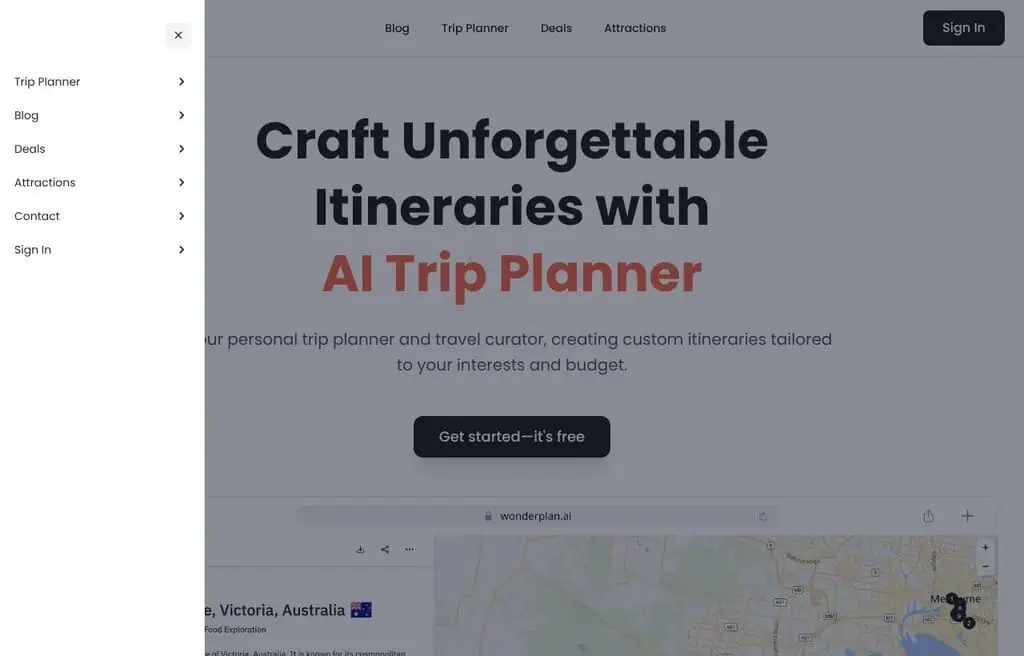
Verdict: Best free planner for budget-conscious travelers.
Type: Freemium | Domain Rating: 45 | Monthly organic traffic: ~6,521 visits
Wonderplan generates personalized itineraries with a clear eye on budget, and it can track spending. It is positioned as a genuinely free AI travel planner.
Set a budget and dates, and it builds a plan that respects the number, then helps you keep tabs on costs as you go.
The honest catch: The polish and depth are a notch below the top paid-leaning tools, and heavy use runs on a credit system.
Pricing: Free with credit-based usage; paid top-ups for heavier planning.
Best for: Budget travelers who want a free, cost-aware itinerary builder.
5. Trip Planner AI
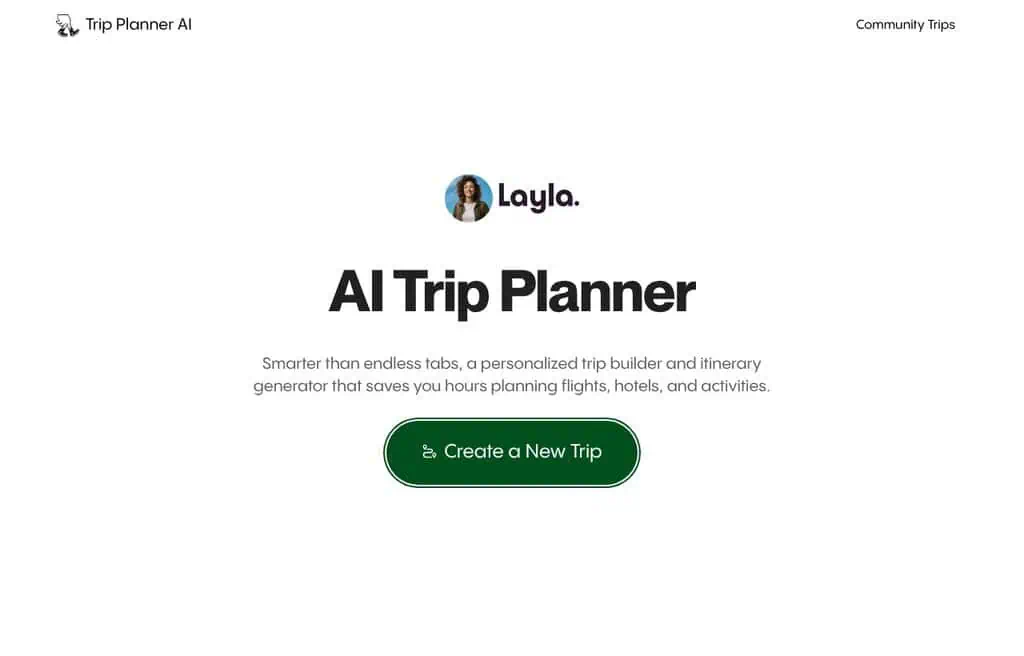
Verdict: Best for social-inspired itineraries and smart routing.
Type: Freemium | Domain Rating: 39 | Monthly organic traffic: ~6,127 visits
Trip Planner AI builds optimized day-by-day itineraries and is strong on smart routes, and it taps social inspiration so you can turn places you saw on Instagram or TikTok into a real plan.
Save a few spots you found on social media, and it stitches them into an efficient route so you are not zig-zagging across a city.
The honest catch: The free plan covers basics; you will hit limits on longer or more frequent trips and want the paid upgrade.
Pricing: Free plan; affordable Pro upgrade for more trips and features (verify current pricing).
Best for: Social-media-inspired travelers who want efficient routing between saved spots.
6. Vacay
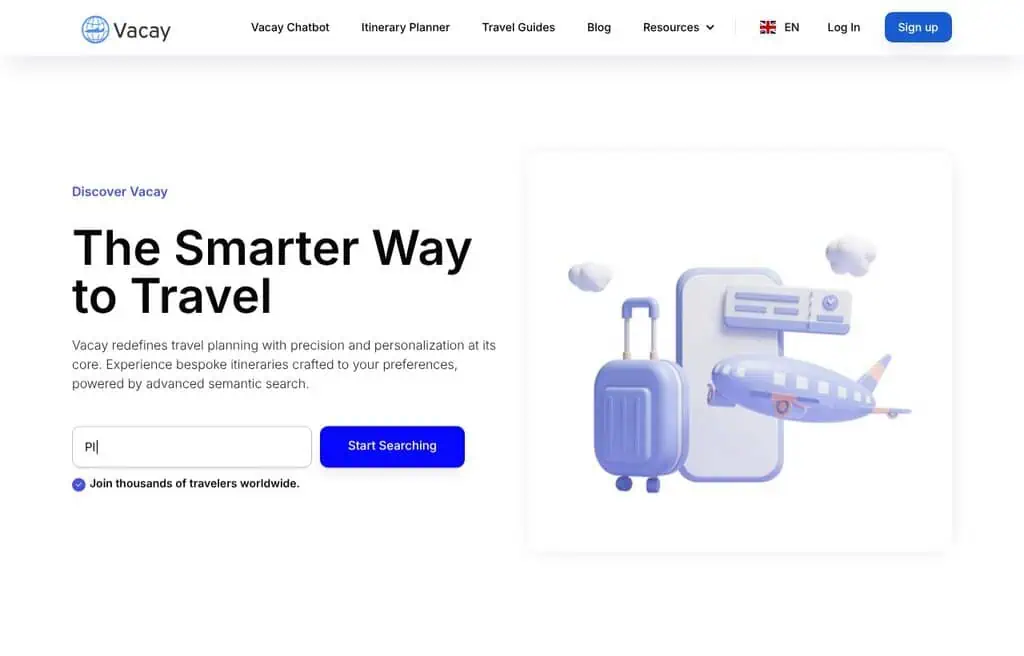
Verdict: Best for personalized itineraries with global insights.
Type: Freemium | Domain Rating: 33 | Monthly organic traffic: ~1,460 visits
Vacay offers AI-driven travel planning with personalized itineraries and destination insights, wrapped in a clean, approachable interface.
Tell it your travel style and it tailors recommendations rather than handing everyone the same tourist checklist.
The honest catch: It is a younger tool, so the ecosystem (integrations, booking) is lighter than the market leaders.
Pricing: Free plan ($0/mo); paid tiers around $9.99/mo and $49/mo for more.
Best for: Travelers who want personalized, style-based itineraries on a budget.
7. Copilot2trip
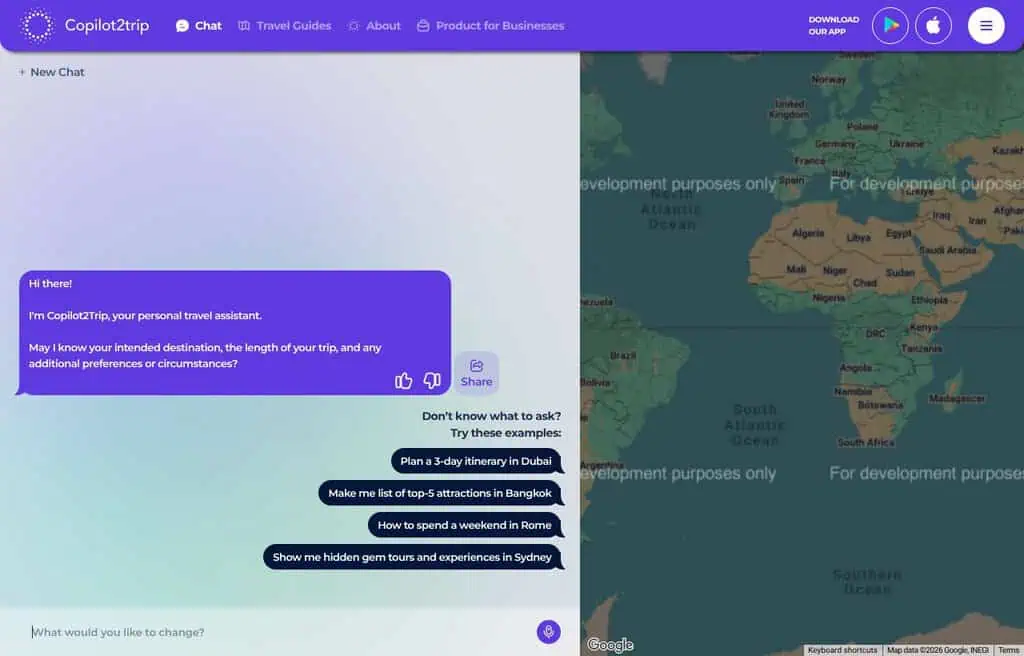
Verdict: Best free planner with interactive maps and adaptive tips.
Type: Free | Domain Rating: 22 | Monthly organic traffic: ~1,181 visits
Copilot2trip crafts itineraries with interactive maps, real-time recommendations, and adaptive suggestions as your plans change.
Build a plan, then let it adjust recommendations when you move a day around or add a stop.
The honest catch: Smaller and less known, so expect fewer polish touches and a lighter community than top tools.
Pricing: Free to use.
Best for: Map-loving travelers who want a free, adaptive planner.
8. GuideGeek

Verdict: Best free AI travel assistant inside messaging apps.
Type: Free | Domain Rating: 45 | Monthly organic traffic: ~755 visits
GuideGeek, from Matador Network, is a free AI travel assistant that lives in WhatsApp (plus Messenger and Instagram). You chat with it like a friend who happens to know every destination.
Message it ‘what’s open in Tokyo on a Monday near Shibuya?’ from WhatsApp and get a fast, conversational answer without opening another app.
The honest catch: Because it is chat-only in messaging apps, there is no visual itinerary board or map workspace.
Pricing: Free.
Best for: Travelers who want quick advice in the messaging apps they already use.
9. Maps GPT
Verdict: Best for turning prompts into custom travel maps.
Type: Freemium | Domain Rating: 12 | Monthly organic traffic: ~119 visits
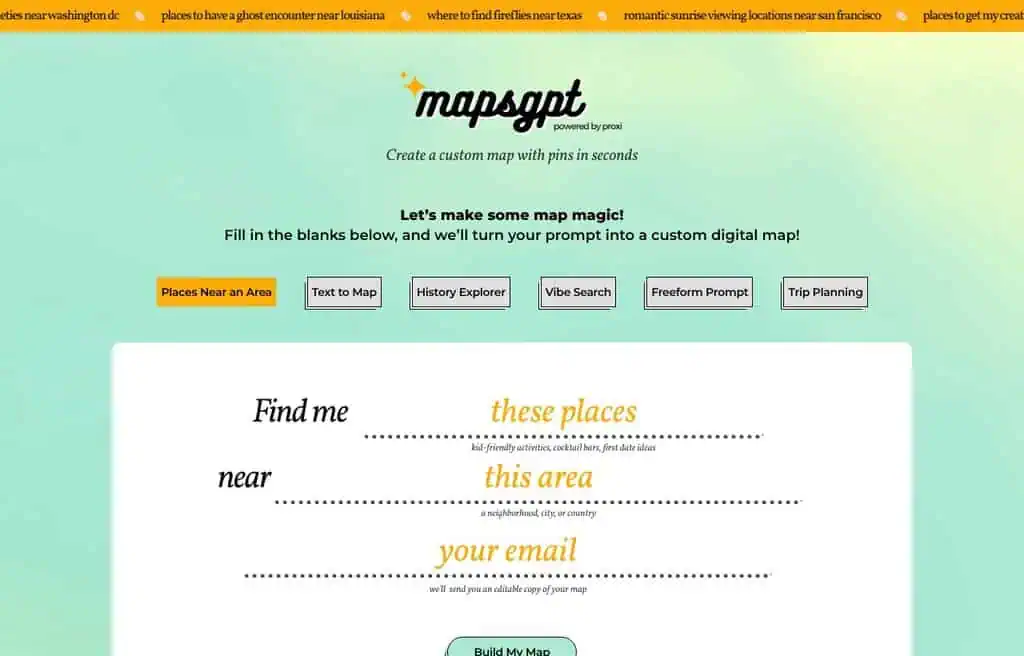
Maps GPT is an AI map maker: describe what you want and it creates a customized, editable map with intuitive search, handy for visual trip planning and sharing routes.
Ask for ‘best coffee and viewpoints in Porto’ and get a shareable custom map instead of a list.
The honest catch: It makes maps, not full itineraries, so pair it with a planner for scheduling.
Pricing: Free tier; paid plan for more maps and features.
Best for: Visual planners who want custom, shareable travel maps.
10. iPlan.ai
Verdict: Best mobile app for fast, personalized day plans.
Type: Freemium | Domain Rating: 36 | Monthly organic traffic: ~96 visits
iPlan.ai is a popular AI travel planner app that generates personalized, day-by-day itineraries quickly, with a strong mobile experience.
On your phone, generate a full multi-day plan for a city in under a minute, then tweak the order.
The honest catch: The free version limits how many trips or days you can generate before a paid upgrade.
Pricing: Free with limits; paid upgrade for unlimited planning (verify current pricing).
Best for: Mobile-first travelers who want quick app-based itineraries.
11. Travelnaut
Verdict: A simple AI helper to tailor and simplify planning.
Type: Freemium | Domain Rating: 9 | Monthly organic traffic: ~74 visits
Travelnaut uses AI to tailor and simplify the planning process, aiming to cut the overwhelm of organizing a trip.
Hand it the basics and let it simplify the first pass of a plan you then refine.
The honest catch: It is a small, lesser-known tool, so treat it as a lightweight helper rather than a complete platform.
Pricing: Free / freemium (verify current pricing).
Best for: Travelers who want a simple AI nudge to start planning.
12. JourneAI
Verdict: For AI-driven, tailored global itineraries.
Type: Freemium | Domain Rating: 13 | Monthly organic traffic: ~54 visits
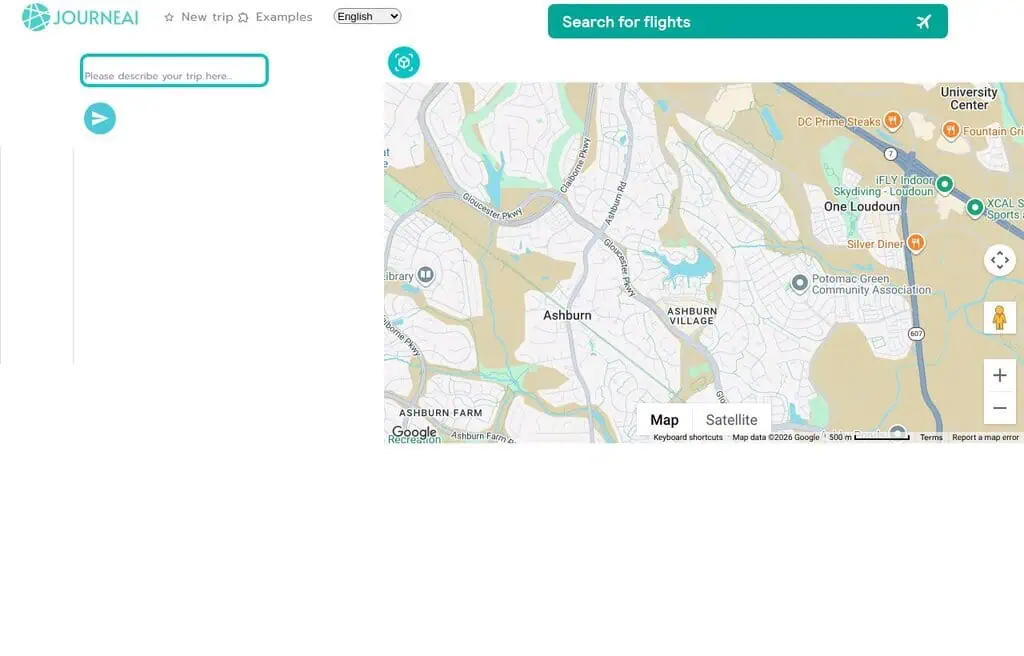
JourneAI generates AI-driven, tailored itineraries for destinations worldwide, focused on personalization.
Useful for a quick personalized outline for an international trip.
The honest catch: Very small footprint and limited track record, so verify details and cross-check its suggestions.
Pricing: Free / freemium (verify on site).
Best for: Travelers wanting a quick personalized global itinerary draft.
13. Swifty
Verdict: Best AI assistant for business travel.
Type: Freemium | Domain Rating: 24 | Monthly organic traffic: ~5 visits
Swifty is an AI assistant built to simplify business travel, handling the repetitive logistics that eat a work trip.
Hand off the back-and-forth of organizing a business trip and let it streamline the admin.
The honest catch: It is focused on business travel, so leisure planners will find it narrow, and it leans toward teams.
Pricing: Freemium / team pricing (check the site).
Best for: Business travelers and teams who want to cut trip admin.
14. Tripnotes (discontinued)

Verdict: Discontinued. Kept here because people still search for it.
Status: Shut down. Tripnotes was acquired by Dorsia in December 2023 and wound down; tripnotes.ai now redirects to a Dorsia newsroom page that returns a 404 (checked 16 August 2026). Use Mindtrip or Layla instead.
Tripnotes combined AI itinerary building with crowd-sourced recommendations, so plans leaned on real traveler input, not just generated suggestions.
The pitch was an AI plan seasoned with community recommendations for each stop.
The honest catch: Smaller community than the giants, and the best features sat behind a paid tier.
Pricing: No longer applicable; the service has shut down.
Was best for: Travelers who wanted AI plans backed by community tips.
No working link: the site is offline.
15. AI Trip Planner (discontinued)

Verdict: Discontinued. Kept here because people still search for it.
Status: Offline. aitripplanner.io still resolves in DNS but refuses all connections, so the planner cannot be reached (checked 16 August 2026). Use Mindtrip or Layla instead.
AI Trip Planner created personalized, efficient travel itineraries from your destination and preferences.
It was a quick way to get a structured itinerary you could edit.
The honest catch: Generic positioning and a small footprint meant it overlapped with stronger, better-known tools.
Pricing: No longer applicable; the site is offline.
Was best for: Travelers who just wanted a fast, no-frills itinerary.
No working link: the site is offline.
16. Where To
Verdict: For location insights and personalized suggestions.
Type: Freemium | Domain Rating: 0 | Monthly organic traffic: ~0 visits
Where To is an AI travel app that surfaces location insights and personalized suggestions to help you decide where to go and what to do.
Helpful early in planning when you are still deciding on a destination.
The honest catch: Niche and lesser-known; use it for ideas, then plan logistics in a fuller tool.
Pricing: Free / freemium (verify on site).
Best for: Undecided travelers who want destination and activity ideas.
17. WanderGenie

Verdict: For AI-driven personalized planning with real-time tweaks.
Type: Freemium | Domain Rating: 1 | Monthly organic traffic: ~0 visits
WanderGenie offers AI-driven personalized trip planning with real-time adjustments, mainly through its mobile app.
Generate a plan on your phone and let it adapt as things change on the ground.
The honest catch: Primarily an app with a small user base, so expect fewer integrations and less polish.
Pricing: Free / freemium (verify on site).
Best for: Mobile travelers who want a simple, adaptive AI planner.
Major Travel Platforms With Built-In AI
These two are not dedicated AI planners, but they are where millions plan and book, and both now bake in AI. They top the raw traffic charts because they are whole platforms, so I rank them separately and honestly.
Google Travel (Trips)
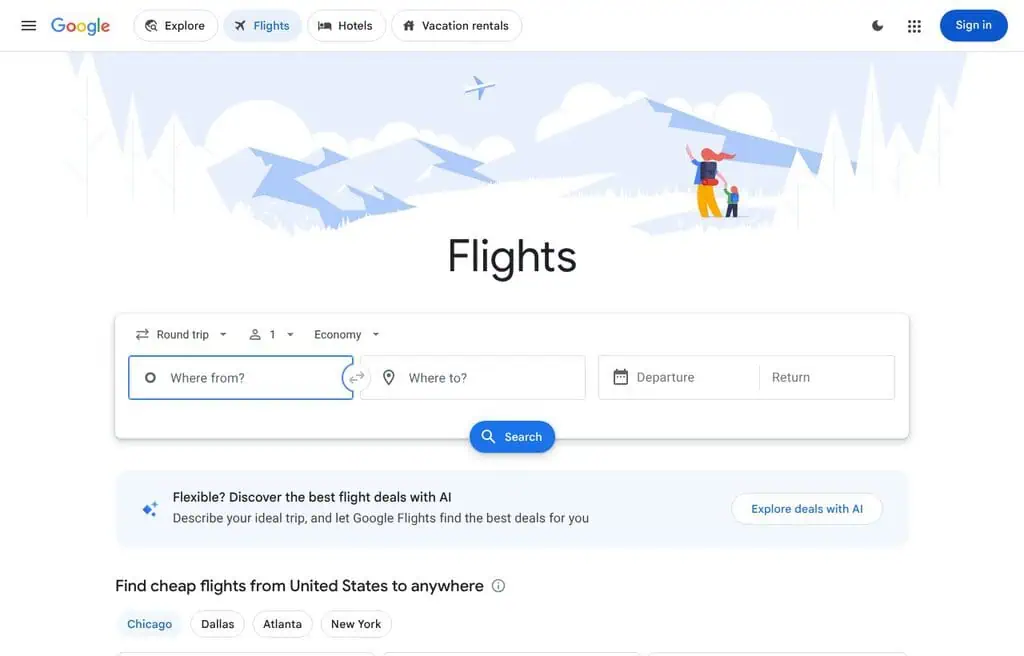
Verdict: Best free option you already have, backed by Google.
Type: Platform | Domain Rating: 99 | Site traffic: ~1,511,010,386 visits (whole platform)
Google Travel ties together flights, hotels, and saved places, syncs your bookings from Gmail, works offline, and increasingly leans on Gemini for trip ideas. It is not a dedicated itinerary builder, but it is the connective tissue of a trip.
Search flights and hotels, save places to a trip, and have your confirmations auto-organized, then use Gemini for suggestions.
The honest catch: It is organization and search more than a true day-by-day AI planner, and the AI suggestions are improving but less tailored than dedicated tools.
Pricing: Free.
Best for: Anyone who books through Google and wants bookings auto-organized in one place.
Trips by TripAdvisor
Verdict: Best for AI plans grounded in real traveler reviews.
Type: Platform | Domain Rating: 93 | Site traffic: ~70,689,132 visits (whole platform)
Trips by TripAdvisor pairs an AI-assisted itinerary builder with the largest bank of real traveler reviews on the web, so suggestions are backed by genuine feedback rather than generated guesses alone.
Build a trip and sanity-check every recommendation against thousands of real reviews before you commit.
The honest catch: The AI layer is lighter and less conversational than purpose-built planners; the real value is the review data.
Pricing: Free.
Best for: Review-driven travelers who want AI suggestions validated by real feedback.
AI planner or itinerary template: Which do you actually need?
A question this page kept getting asked and never answered, so here it is.
Use an itinerary template when the thinking is already done. A template is a structured document: days down the side, times and bookings across. It does not decide anything. If you know where you are going and what you are doing, a template turns that into something you can share with the people travelling with you, and a spreadsheet does it for free.
Use an AI travel planner when the thinking is not done. If you have not decided how to plan a trip beyond the destination, the planner’s value is generating options and sequencing them, including which things to sightsee on which day. It is bad at being a shared document and good at answering “what should we do on Tuesday”.
The combination most people want: plan with an AI tool, then export or paste the result into a template so it survives contact with reality. Most planners here export to PDF or a calendar, and Mindtrip and Trip Planner AI both keep a live itinerary you can share, which covers the template job without a second file.
Where templates beat AI outright is group trips with shared costs, because splitting money is a spreadsheet problem and no planner here does it well.
Free vs paid AI travel planners
Good news: you can plan a great trip without paying anything. The strongest AI travel planner free options are GuideGeek (completely free, in WhatsApp), Wonderplan (free, budget-aware), Google Travel (free), and Copilot2trip. Most others, including Mindtrip, Layla, Trip Planner AI, and Vacay, use a freemium model: a usable free tier plus a paid upgrade for higher limits, more trips, or advanced features.
When is paid worth it? If you travel often, plan multi-city trips, or want the polish of a full workspace with maps and live itineraries, a paid tier (Layla at about $49/year, or Vacay from $9.99/mo) pays for itself in saved hours.
For one trip a year, the free tiers are plenty. As always, verify the current price on the official site before you commit, since AI tools change pricing often.
Best AI travel planner by use case
Not sure which to pick? Match the tool to the job:
- Best all-in-one: Mindtrip, chat, maps, and a live itinerary in one workspace.
- Best free AI travel assistant: GuideGeek, a free travel ai agent right inside WhatsApp.
- Best for budget travelers: Wonderplan, personalized, cost-aware plans.
- Best for social-inspired routes: Trip Planner AI, turns saved Instagram and TikTok spots into smart routes.
- Best mobile AI travel app: iPlan.ai or Layla, fast plans on your phone.
- Best for business travel: Swifty, an AI travel assistant for work trips.
- Best for custom maps: Maps GPT, prompt-to-map for visual planners.
- Best free option you already have: Google Travel, with Gemini help and booking sync.
How to get the best results from any AI travel planner
What do you need to give an AI travel planner to get a usable itinerary?
Five things, and leaving any of them out is why most people’s first attempt comes back generic.
- Dates and pace. “Five days in Lisbon” produces a different plan from “five days in Lisbon, we like slow mornings”.
- Who is going, and your travel dates. Two adults, a toddler and a grandparent is a routing constraint, not a detail, and exact dates change what is open.
- A budget, as a number. “Cheap” means nothing to a model. “About 150 euros a day excluding the hotel” means a lot.
- What you have already booked. Otherwise it will plan around a flight you are not on.
- One thing you refuse to do. Naming a dislike shapes the output more than naming ten likes.
Can AI travel planners book flights and hotels directly?
Mostly no, and the ones that say yes are handing you off.
What actually happens on nearly every tool here is a deep link into a booking partner, where you complete the purchase on the partner’s site and the planner earns a commission. That is not a criticism, it is how the category is funded, but it matters for two practical reasons: the price you see in the planner can be stale by the time you click, and the planner has a financial reason to show you partners it earns from rather than every option.
Treat the itinerary as the plan and book on the airline or hotel site directly, then paste the confirmed times back into the planner. That is also the workflow that keeps your plan accurate.
How accurate are AI travel recommendations?
Good on structure, unreliable on facts that change.
What they get right consistently: the shape of a sensible day, the order to visit things in, realistic travel time between neighbourhoods, and the genuinely well-known places in a city. What they get wrong often enough to check every time: opening hours, whether somewhere closed permanently, ticket prices, whether a place needs booking weeks ahead, and anything seasonal.
The failure mode is confidence. A planner will name a restaurant that shut two years ago in exactly the tone it uses for one that is open. Assume every specific venue needs one check before you build a day around it.
Are AI travel planners better than a travel agent?
Different jobs, and the honest split is by what goes wrong.
An AI planner is better at the research phase: generating options, arranging a sensible route, and doing it in minutes at no cost. A human agent is better when something breaks. Nobody at Mindtrip will rebook you when a strike cancels your connection at 11pm, and for complex multi-stop or high-value trips that recovery is most of what you are paying an agent for.
The practical answer for most trips is neither exclusively: plan with AI, book directly, and keep an agent for the trips where a failure would be expensive.
The difference between a generic plan and a great one is usually the prompt and the follow-through. A few field-tested tips:
- Be specific. Include dates, budget, pace, interests, dietary needs, and dealbreakers. “4 days in Barcelona, no museums, great seafood, lots of walking, $150/day” beats “plan Barcelona.” Spell out which must-see attraction, hotel style, and travel preference matters most, and the AI tailors the sightseeing to you.
- Verify everything. AI can hallucinate opening hours, prices, and even whether a place still exists. Confirm before you rely on it.
- Search your own flights. Most AI travel planners do not book, and their fare guesses drift. Use the plan for structure, then book through a real engine.
- Use it as an idea generator, not a final authority. The best results come from treating the AI plan as a smart draft you refine, not gospel.
Travel planning questions I get asked most
What is the best AI travel planner in 2026? For most people, Mindtrip is the best all-in-one AI travel planner thanks to its combined chat, map, and live itinerary. Layla and Trip Planner AI are excellent alternatives, and GuideGeek is the best fully free option.
Is there a free AI travel planner? Yes. GuideGeek (in WhatsApp), Wonderplan, Google Travel, and Copilot2trip are free, and most other tools offer a free tier. You can plan a full trip without paying.
Can AI plan an entire trip for me? AI can plan the itinerary, suggest activities, and build routes extremely well, but it is not a reliable booking agent. Treat it as a smart travel itinerary generator: let it plan, then verify details and book the flights and hotels yourself.
What is the difference between an AI travel planner and an AI travel agent? An AI travel planner builds itineraries and ideas. A true AI travel agent would also book and transact. Today’s tools are mostly planners, even the ones marketed as “ai travel agents,” so always confirm and book the specifics yourself.
Is Google’s travel AI any good? Google Travel (google travel ai) is excellent for organizing flights, hotels, and saved places, syncing your bookings, and offline access, and Gemini adds idea generation. It is more organizer than dedicated planner, but it is free and you likely already use it.
What about tools like Magic Travel AI or other lesser-known planners? There are dozens of niche AI travel planners (Magic Travel AI, Where To, JourneAI, and more). A few are genuinely useful, but many overlap with the leaders and have tiny user bases, so start with the top-ranked tools above before trying the long tail.
Which AI is best for travel planning overall? For a dedicated tool, Mindtrip. For quick chat-based help, Layla or GuideGeek. And general assistants like ChatGPT and Gemini are surprisingly strong idea generators if you prompt them well, just verify the output, and the same chatbots headline our best AI writing tools guide.
Which AI travel planner should you use?
The AI travel planner category finally grew up in 2026. The best tools, led by Mindtrip, Wanderboat, Trip Planner AI, and Layla, genuinely cut trip planning from hours to minutes, and the free options like GuideGeek and Wonderplan mean you do not need to spend a cent to benefit. The giants, Google Travel and Trips by TripAdvisor, are still where most people book, and both are getting smarter with AI.
The one mindset shift that makes all of this work: use AI travel planning to do the heavy lifting on ideas and structure, then verify and book yourself. Do that, and the right tool turns “I have no idea where to start” into a finished itinerary before your coffee gets cold.
Start with the free tier of the top-ranked tool that fits your style, run one real trip through it, and you will quickly see which one earns a place in your travel routine. For more tested tools and deals, explore our best AI tools hub and grab the weekly AI deal alerts.
Related Posts

The 30 best AI SEO tools in 2026, tested with real money: what each costs, which ones track AI visibility and AI Mode, a...
30 AI writing tools tested across free, freemium and paid tiers, every link checked, plus which AI beats ChatGPT for wri...

61 free AI image generators tested and ranked, every tool link checked September 2026, plus which are truly unlimited an...

Which AI Chrome extension should you install? 132 ranked on real Web Store install, rating and review data, with a pick ...

What Firefox AI actually does, how to enable or disable it, and every one of the 95 AI Firefox add-ons ranked on real da...

30 social media scheduling tools tested for small business: real pricing, every tool link checked September 2026, and th...