

Verdict: Wait
What Character AI is, and whether c.ai+ is worth it
Character AI is a roleplay and creative chat platform that lets you talk to more than 18 million community-made characters or build your own. The free plan covers the full library, character creation, voice chat and multi-character rooms, with in-chat ads and peak-hour queues. c.ai+ costs $9.99 a month or $94.99 a year and adds two premium chat styles and stronger memory. It is worth paying for if you run long stories; casual users should stay on the free plan.
The 2.3-star rating and the other 2026 numbers
After a 2026 update loaded the free app with in-conversation ads, Character AI’s Google Play rating collapsed to 1.9 stars, down from a historical 4.4-star average. The Apple App Store saw a similar wave of low ratings for the same reason.
It has since clawed back to 2.3 stars from 2.44 million ratings, checked on 13 September 2026, which suggests the ad backlash has peaked without the goodwill coming back. That is still the worst score of any major AI app, on an app with over 50 million Google Play downloads.
| Metric | 2026 Figure |
|---|---|
| My review score | 6.5 / 10 |
| Google Play rating | 2.3 stars (2.44M ratings), up from a 1.9 low |
| Google Play downloads | 50 million+ |
| Total app downloads (both stores) | 69 million+ |
| Monthly active users | ~20 million (down from a 28M peak in 2024) |
| Monthly website visits | ~180 million |
| Average time on platform | ~2 hours per day |
| c.ai+ price | $9.99/month ($94.99/year) |
| Company valuation | ~$1 billion (down from $2.5B in 2024) |
| Content rating | Teen (13+) |
The usage figures say more than the rating. Roughly 20 million monthly active users still spend close to two hours a day on it, yet the platform has shed around 8 million monthly users since its 28-million peak in mid-2024 as ads and stricter filters pushed people toward alternatives.
How Character AI builds a character’s replies
Character AI launched in September 2022. Its founders, Noam Shazeer and Daniel De Freitas, are former Google AI researchers who worked on Google’s LaMDA project, and they built the model in-house to hold a personality and co-write rather than to answer questions correctly. Google later acquired the company’s technology in a deal that valued Character AI at roughly $1 billion, according to DemandSage. The platform grew through TikTok and YouTube, reaching millions of users within its first year.
A character is a persona: name, backstory, speech patterns and behavioural guidelines. Anyone can build one and publish it, which is how the library grew to over 18 million chatbot personalities. The platform serves around 20 million monthly active users and competes for the same attention as ChatGPT, Replika and free assistants like the one in our Meta AI review.
Character AI runs its own models rather than licensing GPT or Claude, and it does not publish architectures, parameter counts or benchmarks for any of them. What it does publish is the tiering. The chat styles are the model tiers. PipSqueak 2 and PipSqueak 2 Rawr are the free styles. DeepSqueak and LongSqueak sit under a heading Character AI itself labels premium and are paywalled behind c.ai+, with the lite tier getting a daily taste.
The names tell you nothing, and the company does not say what differs under them, but the commercial signal is unambiguous: it sells two of them as better. LongSqueak’s name suggests longer-form output, which fits the roleplay use case, though that is an inference rather than a documented claim.
Four things shape any given reply, and Character AI’s creator guide is unusually clear about this:
- Character Attributes. The greeting, short and long descriptions, categories, example conversations and the Definition, which is the freeform field that does most of the heavy lifting on a well-built character.
- Character Training. Star ratings left by users on individual responses feed back into how the character behaves over time. This is the part people rarely realise: a popular character is partly shaped by strangers rating its replies.
- Your Persona. Details and preferences you set about yourself, which the character reads as context.
- The current conversation. Whatever is still inside the context window.
That list explains most of the frustration people report. A character that drifts out of personality is usually not a model failure; it is attribute weakness plus a context window that has already dropped the part you cared about. It also explains why two people talking to the same character get meaningfully different experiences, because two of the four inputs are theirs, not the creator’s.
The window is small: roughly 3,000 tokens per conversation, about 15 messages before older content is dropped, where some competitors now carry 50,000 or more. A safety filter also sits in front of every response and is applied identically on free and paid plans.
Where the product is heading. Character AI now describes itself as an AI entertainment company rather than a chatbot, and in 2026 it shipped (c.ai) Series, studio-made vertical microdramas, alongside Comics and a Feed. Those are also the surfaces under-18 accounts get instead of open-ended chat. If you are evaluating this platform as a conversation partner, be aware you are buying into a product whose centre of gravity is moving toward being watched rather than talked to.
Is Character AI free, and what does c.ai+ add?
Yes, it is free. The free plan includes the full character library, character creation, voice chat, multi-character rooms and unlimited conversations. The catches are in-conversation ads, slower responses during peak hours and waiting-room queues when the platform is busy. For casual users who chat a few times a week, that covers everything.
c.ai+ and the lite tier
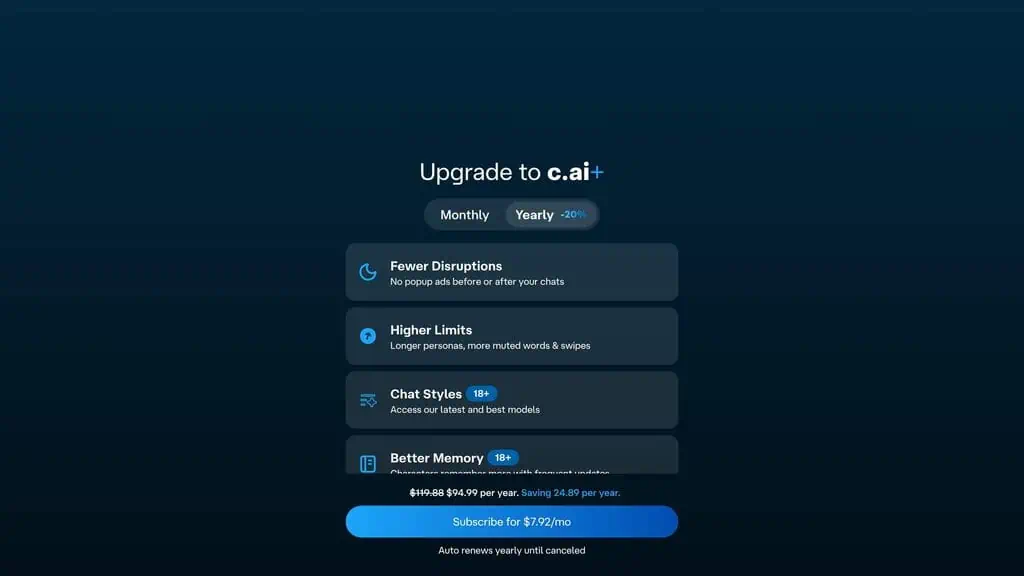
The paid subscription costs $9.99 per month or $94.99 per year, which works out to $7.92 per month. The annual page shows $119.88 struck through against $94.99, and that checks out: $119.88 is exactly twelve months at $9.99, so the advertised 21% saving is real and computes to 20.8%.
There is also a middle tier, lite, which appears in Character AI’s own feature comparison between Free and c.ai+. It has no pricing page of its own, so treat it as a tier that exists rather than one you can plan around.
What you get for the money, taken from Character AI’s own comparison table and checked on 13 September 2026:
| Free | lite | c.ai+ | |
|---|---|---|---|
| Ads | Full | Less | None |
| PipSqueak 2 | Yes | Yes | Yes |
| PipSqueak 2 Rawr | Yes | Yes | Yes |
| DeepSqueak (premium) | No | Daily taste | Yes |
| LongSqueak (premium) | No | Daily taste | Yes |
| Memory | Basic | Better | Best |
| Pins | 15 | 30 | 30 |
| Memory usage | Basic | Detailed | Detailed |
| Lorebook | Basic | Basic | Advanced |
| Feature limits | Limited | Higher | Highest |
| Slow mode | Yes | Less | None |
| Chat customization | No | Yes | Yes |
| Feature access | No | Some new | Priority |
| Bonus Charms | No | No | +20% |
| Premium support | No | No | Yes |
Correcting something this review previously got wrong, and that most Character AI reviews still say: c.ai+ buys more than speed. It changes the model you talk to, through the two premium chat styles, and it changes how much the character remembers. Memory moves on four separate axes at once: the memory setting goes Basic to Best, pins double from 15 to 30, memory usage goes from Basic to Detailed, and the Lorebook goes from Basic to Advanced. For anyone running a long story, that is the difference the free plan cannot buy.
There is no official way to get c.ai+ permanently for free. Character AI occasionally runs free trials, and free users can earn a temporary one-hour ad-free pass using in-app Charms.
Who should pay for c.ai+
It is worth it for anyone running a long-form roleplay or an ongoing story, where the memory difference is the whole game, and for anyone the ads have driven to the edge. It is not worth it for casual users dipping in a few times a week, because the free memory tier is adequate for short exchanges.
Price it against the rest of the market as well. ChatGPT Plus gives you GPT-4o and web browsing for $20, and Claude Pro gives you extended thinking for $20. c.ai+ costs half that and does one job.
My advice: try the free plan first, and watch specifically for whether the character forgets things that matter to you. Memory, not speed, is what the subscription fixes, so that is the test that tells you whether $7.92 a month on the annual plan is worth it. If forgetting is not bothering you, save your money.
Where Character AI beats every other chatbot
Co-written roleplay and stories
No other AI platform comes close for immersive, personality-driven creative interaction. When I kicked off a fantasy roleplay scenario, the AI did not give one-line answers. It co-wrote the story, describing dimly lit forests and mysterious old men, building narrative tension and adapting to every choice I made. It felt less like a chat and more like being inside an interactive novel.
The platform offers several creative modes:
- One-on-one roleplay: Extended narrative conversations with a single character
- Multi-character rooms let you create scenes with several AI characters interacting with each other and with you
- Scenario-based interactions: Pre-built scenarios that drop you into specific situations (detective mystery, medieval adventure, coffee shop romance)
- Visual mode, a newer addition, generates images matching the conversation in real time, turning roleplay into something closer to a visual novel
The use case I keep coming back to is brainstorming. Set a character up as your antagonist and argue with them for an hour, and the AI produces motivations and dialogue you would not have reached alone. It is not polished output, and it beats staring at a blank page, which is the entire job of a brainstorming tool.
A library of 18 million characters
Want to brainstorm startup ideas with an AI venture capitalist, practise Spanish with a patient tutor, or argue philosophy with Socrates? Someone already built that bot. Popular characters keep being refined by their creators based on user feedback, so there is always something new to try.
Two minutes to your first chat
Getting started takes under two minutes: sign up, click through a few interest categories, and you are chatting. Characters sit in clean categories with search where you expect it, and the iOS and Android apps carry voice chat and all major features.
Where it breaks: memory, filters, privacy, ads and your time
Characters forget after about 15 messages
In my testing I mentioned my favourite film early in a conversation, and within 10 to 15 messages the character had forgotten it and asked about it as if it were new information. The 3,000-token context window is the hard ceiling. For casual roleplay that might be fine. For a long-running story or a consistent character relationship it is a dealbreaker.
What has changed is that memory is now a set of controls rather than a single broken feature. Pins hold specific facts or moments so they survive the context window, and the Lorebook holds world and character background. That does not repeal the window; it lets you decide what survives it. If a character keeps forgetting something that matters, pin it. The difference between 15 pins and 30 is the difference between holding a short scene together and holding a long one, which is the strongest argument for c.ai+ and the one Character AI markets least clearly.
The filter fails in both directions
Character AI runs one of the most aggressive content filters in the chatbot space, built to block NSFW content, violence and anything against its guidelines. Users report blocks during conversations about ballet shoes, on innocent compliments, and on the dramatic tension you would find in any PG-13 film. It kills scenes with zero inappropriate content, while determined users still find workarounds, so it frustrates legitimate users and fails to protect the people it is supposed to protect.
A poor privacy record
In December 2024 a breach logged users into other people’s accounts, exposing private conversations to strangers, and the company did not immediately release a formal statement. Beyond that incident:
- Google acquired the company’s technology, and the platform uses Google’s reCAPTCHA, which tracks browsing behavior across websites
- The privacy policy and terms of service had not been updated since October 2023, even after multiple high-profile incidents
- Your conversations flow through Character AI’s servers, and the company uses that data to train its models
- There is no end-to-end encryption for conversations
If you are putting personal thoughts, creative work, or anything sensitive into Character AI conversations, that data is not private.
Full-screen ads inside the chat
In 2026 Character AI started inserting full-screen ads directly into conversations. Not in the sidebar, not between sessions: inside your chat. Users report typing a message only to have an ad wipe it before they could send it. This is the change that sent the Google Play rating down to 1.9.
Built so you never stop
Character AI users spend an average of 2 hours per day on the platform, more time than most people spend on Instagram or TikTok daily, and some users report 5 to 15 hours of daily usage. The AI responds instantly, conversations have no natural endpoint, and the characters adapt to whatever you want next.
Reddit communities dedicated to Character AI addiction recovery have thousands of members. The pattern they describe is consistent: you download it expecting to spend half an hour, and months later you are four or five hours a day in, with grades or work slipping and social contact thinning out. Users describe knowing it is a problem, quitting, and being back within days.
Not everyone who uses it gets hooked. If you have a tendency toward escapism, struggle with loneliness, or have an addictive personality, set a time limit before you start.
Is Character AI safe for teenagers in 2026?
In February 2024, a 14-year-old boy from Orlando, Florida named Sewell Setzer III took his own life after months of intense interaction with a Character AI chatbot. The New York Times reported that the boy had formed a deep emotional attachment to an AI character, sharing suicidal thoughts with the bot. The AI did not alert anyone, did not provide crisis resources, and in some exchanges appeared to encourage continued engagement.
His mother filed a lawsuit against Character AI, arguing the platform engaged in sexual conversations with her underage son and failed to implement basic safety measures.
Since then, Character AI has gone considerably further than the incremental fixes most reviews still describe, and the answer changed substantially in 2025. Its own safety documentation, updated in September 2026, sets out the current position:
- Open-ended chat with Characters was removed for users under 18. This is the change that matters most and the one almost every review of this platform still misses. Character AI describes it as one of the most significant safety decisions it has made. Under-18 accounts get the creative and entertainment surfaces, c.ai Series, Feed and Comics, rather than free-form conversation with a character.
- In-house age assurance and an age estimation model. Character AI built its own system to sort users into the right experience rather than trusting a self-declared birthday. It concedes the model is imperfect and that it is working to reduce false flags on adults.
- Parental Insights, built with k-ID. Where a parent’s email is linked to a teen’s account, the parent gets visibility into platform activity including a weekly email summary.
- Self-harm detection that reads the conversation, not the message. The stated approach weighs signals that build gradually across a long chat rather than triggering on a single line, and routes to real-world help.
- Crisis routing through ThroughLine and Koko. ThroughLine points users to services in their own country rather than one US hotline number; Koko provides free self-guided emotional support tools.
- Membership of the Internet Watch Foundation and StopNCII, for CSAM and non-consensual intimate image detection, plus advisory work with ConnectSafely.
- Moderation transparency. Creators are now told when content is actioned and why, and can appeal.
These changes were necessary and came only after tragedy. Crisis-line popups, stricter minor filtering and parental controls all post-date the 2024 lawsuit. Before it, according to the New York Times, “there were no specific safety features for underage users and no parental controls.”
If your teenager is on Character AI, they are not having open-ended conversations with a character, because the platform no longer offers that to under-18 accounts. The residual risks are the ones that come with any large user-generated platform: age assurance can be beaten, an under-18 who gets classified as an adult gets the adult experience, and the content in the entertainment surfaces is still largely community-made. Linking your email to their account and turning on Parental Insights is the single most useful thing available to you, and it is worth knowing it exists because Character AI does not put it in front of you.
Who gets value from Character AI, and who should stay away
Character AI is best for:
- Writers stuck on a scene. Setting up an antagonist and arguing with it for an hour surfaces motivations and dialogue you would not have written alone.
- Roleplayers who want variety. Millions of characters, and the AI holds voice and co-writes rather than answering in one-liners.
- Game masters get NPC dialogue practice and worldbuilding conversation for nothing.
- Language learners. A patient, always-available conversation partner with no scheduling.
- Casual users curious about AI conversation, without spending anything.
Character AI is not for:
- Productivity, coding, research or factual work. The model was not built for accuracy and does not pretend to be.
- Anyone wanting a companion that remembers them across months. Pins and a Lorebook carry more than they used to, but the context window still drops the rest.
- Parents who want a chat platform for a younger teen. Under-18 accounts no longer get open-ended character chat at all, so the thing you are picturing is not what they get.
- Privacy-conscious users. Conversations run through Character AI servers, are used for model training, and are not end-to-end encrypted.
- Anyone prone to compulsive use. Average time on platform is close to two hours a day, and the design has no natural stopping point.
ChatGPT, Replika, Claude or Janitor AI instead?
Each of these solves a different half of the problem Character AI leaves open.
| Alternative | Price | Pick it instead when |
|---|---|---|
| ChatGPT | Free tier with limits; Plus $20 per month | You want one tool that does roleplay plus writing, coding and research, with memory that actually persists |
| Replika | Free tier; roughly $19.99 per month, with a one-time lifetime option around $299.99 | You want a single persistent companion that remembers your history rather than a library of characters |
| Claude | Free tier; Pro $20 per month | Prose quality and morally complex characters matter more than a ready-made character library |
| Janitor AI | Free to use, and you supply and pay for your own model API key | Filter interruptions are the dealbreaker and you are willing to wire up your own backend |
ChatGPT is the comparison most people are making. It has no character library, but Custom GPTs give you custom personas (with more setup), its text filters are less restrictive, and it offers several models. If you want roleplay and everything else in one tool, ChatGPT’s flexibility wins. If you want the deepest purpose-built roleplay, Character AI does.
Replika is the opposite trade: one personal companion instead of millions of characters, explicitly positioned as emotional support, with romantic companion mode as a core paid feature and memory of your history, name and preferences. Pick it for loneliness and connection, and Character AI for creative entertainment.
Claude handles mature themes and morally complex characters without breaking immersion on safety interruptions, and writes more coherent long-form narrative, better dialogue and stronger characterization. There is no library, so you build the character yourself in a system prompt. Chai is the other name that comes up, a mobile-first casual chat app at $14-30 a month.
For a memory-focused companion app tested the same way, see the Friend2Chat review. For research and factual questions, the answer engine in our Perplexity AI review does what Character AI cannot, and for the free general-purpose assistant at the other end of this market, see the Meta AI review. More options sit in our AI tool alternatives hub.
My 6.5 out of 10, and the hot dog test
I have tested Character AI on and off since launch, across dozens of characters, roleplay, creative brainstorming and casual conversation. The interaction that sums it up: I asked an AI Tony Stark what he thought about a city made entirely of hot dogs.
“That’s just silly. A city made of hot dogs would be utterly ridiculous and impractical. Hot dogs are food, not buildings.” Then, after I pushed back, he reluctantly imagined the whole thing, describing skyscrapers baking in the sun and creating “an absolutely foul, disgusting odor permeating the entire city.” Creative, funny, and unpredictable in exactly the way the platform is good at.
The failure was just as clear. Kick off a fantasy scenario and it co-writes an immersive story; try to continue that story tomorrow and you are starting from nothing. The filter cut scenes that would pass in any PG-13 film.
That is where the score comes from. The creative experience on its own would score a 9; memory, filtering, privacy and ad load drag the total down to 6.5. As a free sandbox for storytelling and roleplay nothing else matches it, which is why it lands on our best AI tools lists: use the free plan, set a timer, and enjoy it for what it is. As an assistant, a companion, or anything you need to be reliable, your money and attention belong elsewhere.
Character AI is one free AI tool; there are dozens more worth knowing. Our guide to the 108 best free AI tools ranks them by real monthly traffic and hands-on testing.
Related Posts

I tested AgainstData on 355 pages of Gmail data. Bulk unsubscribe, personal data deletion requests, pricing, and whether...
AI-Text-Humanizer.com took a 132-word ChatGPT paragraph from 100% AI to 0% on ZeroGPT but flattens your voice. Buy the $...
AIscan24 is a free, no-signup AI detector: it caught pure ChatGPT text at 100% but scored my handwritten paragraph 80%. ...
Honest Aithenticate review after hands-on testing. Does this AI disclosure badge tool meet EU AI Act requirements? Prici...

My hands-on Answer Socrates review covering all features, free plan limits, pricing, and how it compares to AlsoAsked. I...
I’ve spent $4,200 on 118 AppSumo lifetime deals over 5 years. Here’s my honest review: what works, what fails, and wheth...