

Should you pay $4.99 for a CosmoQuick job post?
| Field | Detail |
|---|---|
| Tool | CosmoQuick |
| Category | Hiring platform / job post distribution network with built-in ATS |
| Best use case | Small teams and founders hiring standardized, high-volume roles in India on a tight budget |
| Not for | Senior or executive searches, and buyers who need a proven track record first |
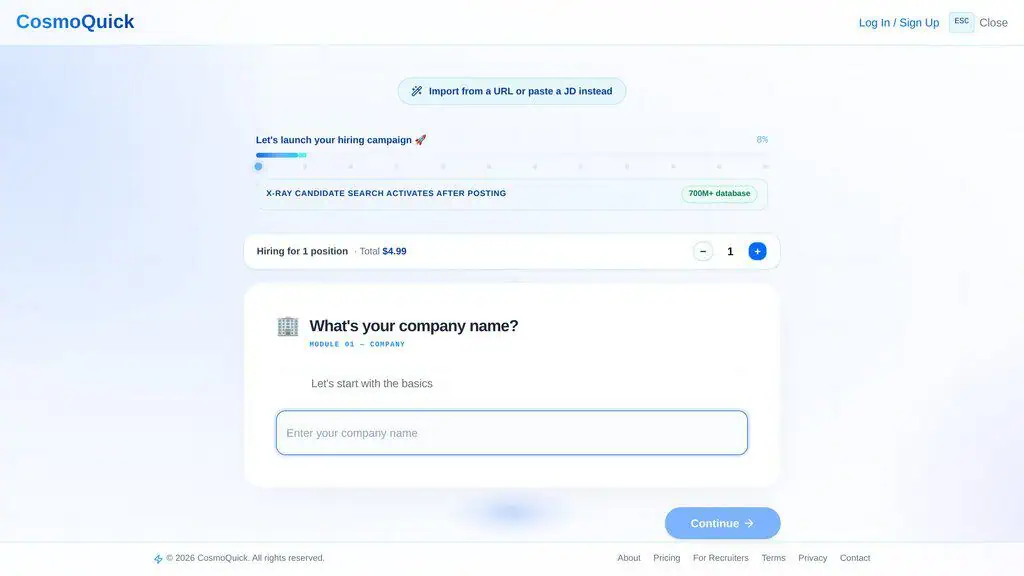
| Price | $4.99 per job post (₹99 in India), no subscription required. Free Recruiter OS tier for up to 3 hiring requests. Paid plans $9 to $99 per month. MIRA sourcing add-on $53 one-time per role. Checked August 1, 2026. |
| Evidence | Reach, database size and completed-hire figures are self-reported and not independently audited |
| Verdict | Worth a $4.99 test on one real role, not worth a monthly commitment until you see your own numbers |
Disclosure: I have not run a full hiring cycle on CosmoQuick with my own money yet. Everything here comes from the public product, the pricing page, the manifesto, and third-party coverage, all checked on August 1, 2026. Where a number is the company’s claim rather than something independently verified, I say so. CosmoQuick did not pay for or review this article, and the links to their site are not affiliate links. If I run a real role through it, I’ll update this review with the actual numbers. Found something out of date? Tell me and I’ll fix it.
What is CosmoQuick?
CosmoQuick is a hiring platform that distributes a single job post across 20+ job boards, partner sites and private hiring communities on WhatsApp, Telegram, Reddit and Discord, then gives you an applicant tracking system and AI screening tools to handle the responses. It charges a flat $4.99 per job post (₹99 in India) instead of a subscription or a placement commission, and positions itself as a replacement for both job portals and recruitment agencies. Most job boards charge you for a place to park a listing; CosmoQuick charges you $4.99 to push that listing somewhere.
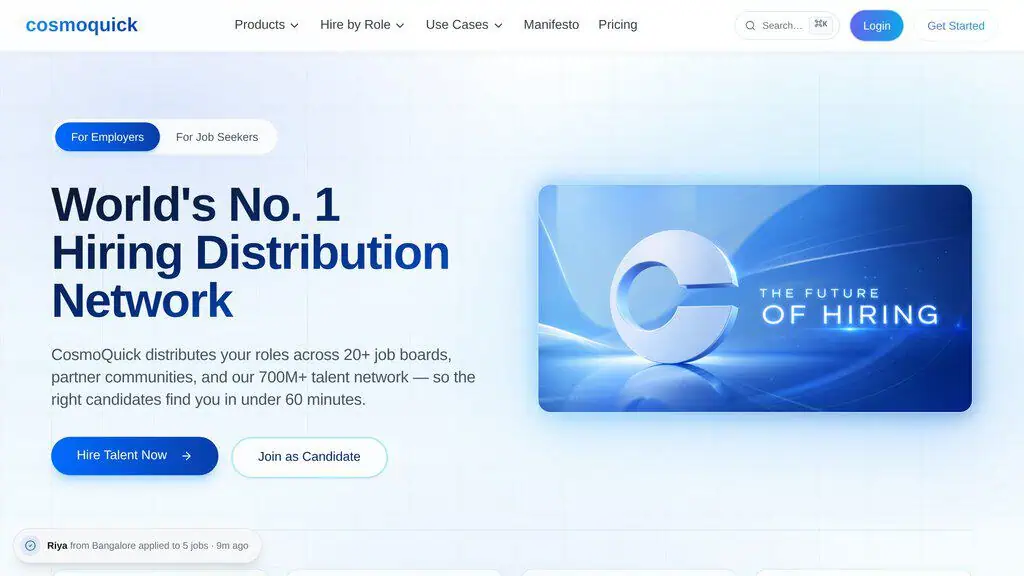
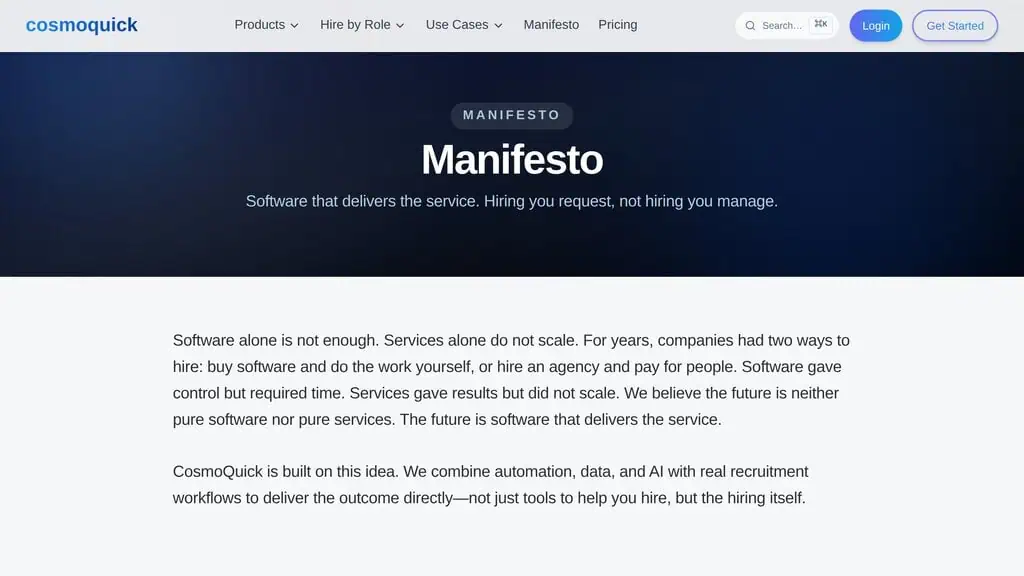
The company calls itself the “World’s No. 1 Hiring Distribution Network,” which is the kind of claim I ignore on any site. The model underneath is coherent. Their manifesto page explains it in one line: “software that delivers the service.” Recruitment software gives you control but leaves the work with you; agencies deliver outcomes but cannot scale, because every new client needs more humans. CosmoQuick wants to automate what agencies do manually and still sell the result.
I don’t agree with every part of that thesis. Judgment-heavy senior hiring isn’t going to be automated well any time soon, and the manifesto admits as much by saying they start with “high-volume, standardized roles where matching matters more than long interviews.” That is an honest scoping statement, and it tells you exactly where the product should work best today.
How one post moves from intake to offer
- Intake. You describe the role. The platform generates a structured job description and an application form, and the AI rewrites the job description for clarity and reach.
- Board syndication. The listing is pushed to 20+ partner destinations including Google Jobs, Indeed, SimplyHired, ZipRecruiter, Jooble and Adzuna.
- Community circulation. The same listing is forwarded into WhatsApp groups, Telegram channels, subreddits, Discord servers, Slack feeds and city-specific recruitment networks. This is the part conventional job portals do not do.
- Optional outbound sourcing. MIRA, the platform’s AI recruitment agent, sources from the claimed 700M+ profile database, runs personalized outreach, and ranks candidates.
- Screening. Applications land in the native ATS with AI shortlisting, plus async video and voice interviews that are scored automatically.
- Close. An interview scheduler books to your calendar, and an offer letter generator produces the offer and onboarding pack.
CosmoQuick does not disclose which AI models power the job description rewriting, screening scores, or MIRA’s ranking.
Who is behind it?
CosmoQuick is run by founder Ayush Singh and is a Microsoft for Startups partner, per the badge on their own footer. The company has picked up coverage in Indian outlets including The Economic Times, Bharat Express and DailyHunt, and issued a wire release through IANS.
The IANS piece carries an explicit disclaimer that it is third-party press release content and does not reflect IANS editorial views. That is normal for startup PR and doesn’t make CosmoQuick less legitimate. It just means “as featured in” logos should be read as distribution, not as vetting.
CosmoQuick pricing, checked August 1, 2026
CosmoQuick costs $4.99 per job post with no subscription, or $9 to $99 per month for its Recruiter OS plans. Job seekers can use the ATS resume scorer, browse jobs and get basic resume tips free, with Pro and Elite career plans at $19 and $29 per month. All prices below were checked directly on the CosmoQuick pricing page on August 1, 2026.
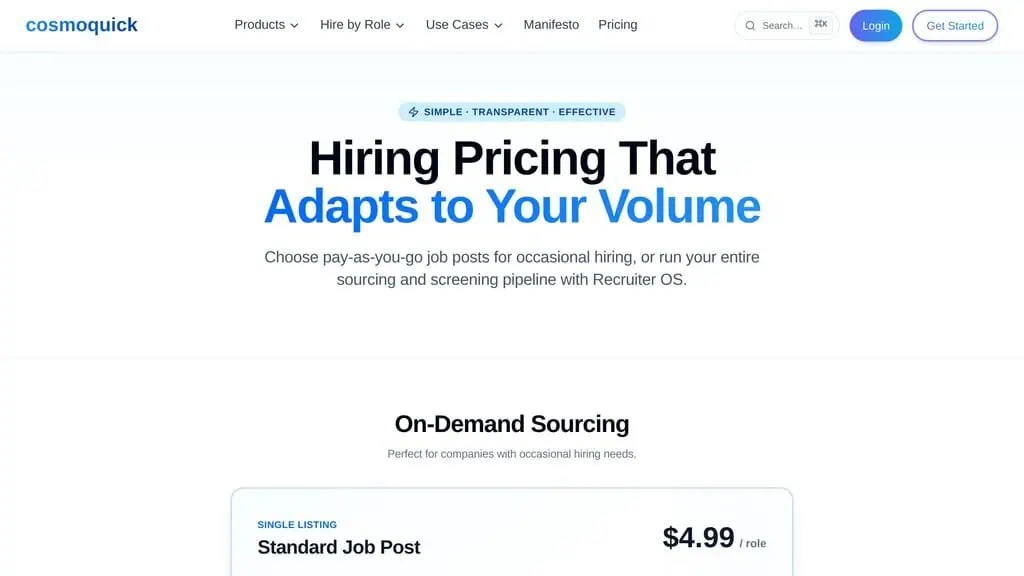
| Plan | Price | What you get | Best for |
|---|---|---|---|
| Standard Job Post | $4.99 per role (₹99 in India) | 30-day listing, AI-rewritten job description, social blast, community circulation, native ATS, AI screening interview tool | One-off hiring |
| Recruiter OS Free | $0/month | Up to 3 active hiring requests, basic ATS pipeline, manual scheduling, CTC calculator | Testing the workflow |
| Recruiter OS Core | $9/month | Unlimited hiring requests, 5 skill certifications, interview scheduling and scorecards, offer generation, Verified Hiring Partner badge | Small in-house teams |
| Recruiter OS Pro | $19/month | Everything in Core, JD auto-pipeline with ranked matches, LinkedIn Chrome extension, AI matching and outreach, hiring velocity analytics | Recruiters hiring monthly |
| CosmoQuick Unlimited | $99/month | Unlimited active postings, sourcing from 700M+ profiles, 15+ partner boards, auto-circulation in 100+ communities, AI shortlisting, premium support | Agencies and high-volume hiring |
| MIRA AI add-on | $53 one-time per role | Autonomous crawling of public talent directories, personalized outreach campaigns, automatic vetting and ranking | Hard-to-fill roles |
The free Recruiter OS tier does not include distribution: pushing a role out still requires the $4.99 post. For context on the entry price, SHRM’s 2025 benchmarking data puts the average US cost per hire at $5,475 for non-executive roles, and far higher for executive hires. A $4.99 posting fee doesn’t replace the rest of the cost of hiring, but it removes any reason to be precious about testing a role.
The homepage and the pricing page disagree
The homepage widget shows Core at $19/month and Pro at $29/month, while the dedicated pricing page shows Core at $9 and Pro at $19, plus a Free tier and the $99 Unlimited plan that the homepage does not mention at all. The about page also mentions a “10% flat commission,” which sits oddly next to the “no commissions” line on the homepage.
Fast-moving startups outrun their own copy constantly, so I don’t read that as a red flag. It is still a practical risk for you: check the number at checkout, treat the pricing page as the source of truth rather than the homepage, and if you are buying a monthly plan, screenshot what you agreed to.
Why pushing a post beats parking it
The useful idea in CosmoQuick is that a job post should be pushed, not parked. Portals collect the fee and you still do the distribution yourself: your own WhatsApp groups, a LinkedIn post, a message to three friends. CosmoQuick is built to do that part for you.
Candidates who already have jobs aren’t browsing listings on a Tuesday afternoon. They are in a Telegram channel for their city, a subreddit for their stack, or a WhatsApp group from their last company. If you run a small team in Bangalore or Coimbatore and need a sales executive, a WhatsApp forward in the right local group will beat a premium portal listing more often than the portal would like you to believe.
Their own site pitches it as “Everything a ₹50K agency does, at 0.01% cost.” That is marketing language and you should discount it accordingly. The underlying mechanic, one input distributed to many outputs, is still a real advantage over paying separately for a listing on each platform.
ATS, AI screening and MIRA behind the fee
Behind the posting fee sits a stack that would normally be three separate subscriptions. For a small business owner, the ATS is arguably more valuable than the distribution. If you’ve ever run a hiring round out of a Gmail inbox and a spreadsheet, you know how fast that collapses at 40 applicants. Having applications land in a pipeline with ranking and screening attached, for the price of one coffee, is a real quality-of-life upgrade.
MIRA is their conversational AI recruitment agent. You describe the role, and it optimizes the job description, posts to platforms, sources from the profile database, runs outreach, screens candidates and generates offer letters. It is free to try for 2 runs with no credit card, and $53 one-time per role as an autonomous sourcing add-on. The MIRA page says she activates the moment you post a job, so you post the role first and MIRA takes it from there.

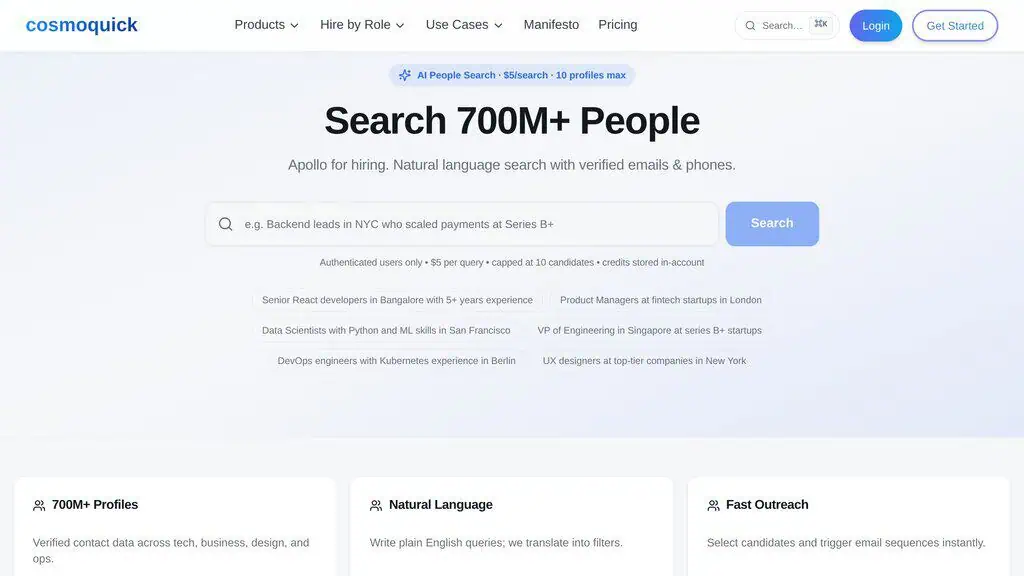
The people search is specific about its terms on the page itself: $5 per query, capped at 10 candidates, authenticated users only, credits stored in your account. They describe it as “Apollo for hiring,” which is a fair comparison and a useful mental model if you have used Apollo before.
There is also a free tools suite that is decent link-bait but usable: a job title standardizer, a job ad bias and clarity checker, a skills extractor, a resume red flag detector, a CTC calculator and a JD generator. If you want to see what good and bad AI tooling looks like across categories, our best AI tools roundups cover the same ground in more depth.
CosmoQuick vs Naukri, Apna, Indeed and LinkedIn
CosmoQuick is not a straight replacement for any of these. Established portals have scale, brand trust with candidates, and years of data. CosmoQuick has price, bundled tooling, and a distribution model built for how candidates behave now. Those are different bets, and for a role under ₹10 lakh a year, the second bet costs almost nothing to place, which is why the honest test is running it alongside your normal channel rather than instead of it.
| CosmoQuick | Traditional job portals | |
|---|---|---|
| Cost model | Flat $4.99 per post, or $9 to $99/month | Per-listing fees, credit packs, or annual contracts |
| Distribution | Syndicated to 20+ boards plus private communities | Mostly your listing on their own property |
| ATS included | Yes, native, at the $4.99 tier | Usually a separate paid product |
| AI screening | Included, with async video and voice | Premium add-on where available |
| Sourcing database | 700M+ profiles claimed, with contact details | Resume database, usually a separate subscription |
| Track record | Young platform, thin third-party review base | Decades of data, known quantity |
If one of the established platforms fits better, this is when to pick it:
| Alternative | Price | Pick it instead when |
|---|---|---|
| Naukri | ₹400 per standard posting up to ₹1,650 for a Hot Vacancy, plus GST. Resdex database access from around ₹55,000 for 3 months | You need brand recognition with Indian candidates and a deep resume database more than you need low posting cost |
| Apna | Not published. Classic, Premium and Super Premium plans are quoted by their sales team | You are hiring blue-collar, frontline or entry-level roles at volume and want a candidate base built for exactly that |
| Indeed | Free to post, with optional Sponsored Jobs billed on a pay-per-application or daily budget model | You want zero upfront cost and are willing to pay only when applications actually arrive |
| LinkedIn Jobs | One free basic listing at a time, with Promoted Jobs billed against a daily budget you set | You are hiring skilled, professional or senior roles where the candidate’s work history and network matter |
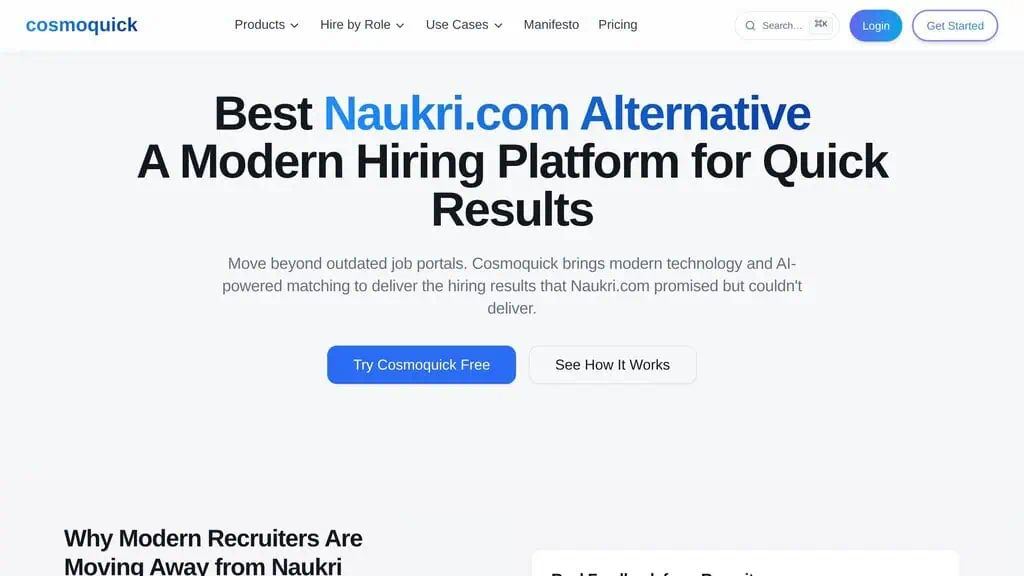
CosmoQuick maintains alternative pages against Naukri, Apna, Indeed, LinkedIn, Monster, ZipRecruiter and others, and quotes a LinkedIn comparison of ₹17,000+ per post. I did not independently verify that number, and LinkedIn’s job posting cost varies by market and bidding, so treat it as their framing rather than a fixed fact.
Reading the social proof carefully
The homepage carries a logo strip with Meesho, CRED, Tata, Y Combinator, Zomato, Blinkit, Adani and Airtel under the heading “Used by people in.” Read that heading carefully. It says people at those companies use CosmoQuick, which isn’t the same claim as those companies being enterprise customers. It is worded honestly rather than “trusted by,” but a lot of readers will skim it as a customer list.
The about page states 100+ companies served and 5,000+ successful hires, while the homepage references 500+ other companies. The three named testimonials are from small companies with first-name or short attributions. On Trustpilot, the listing showed a 4-star average from just 2 reviews as of August 1, 2026, a sample too small to mean anything in either direction.
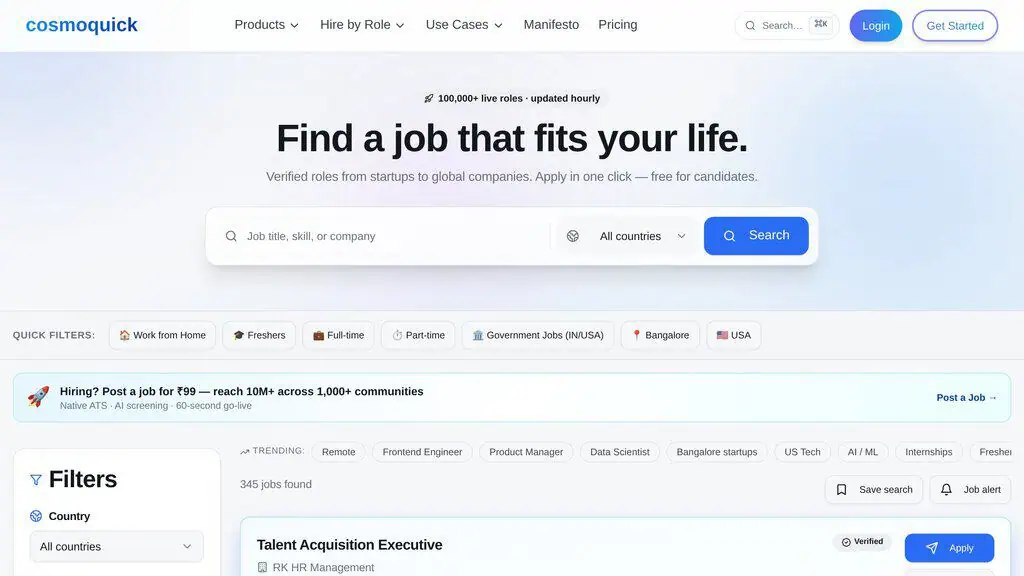
One more check you can do in ten seconds. Their browse page advertises “100,000+ live roles, updated hourly,” and when I opened it with no filters applied it returned 345 jobs. Those are two different pools: the big number is aggregated listings from across the web, the smaller one is what surfaces in the default view. That is normal for a job aggregator, and a reminder that the candidate side of the marketplace is still building.
So judge CosmoQuick on its outbound distribution into communities and partner boards, not on the size of its native audience. What the social proof adds up to isn’t “avoid this.” It’s “this is early.”
Who CosmoQuick is built for
- Startups and small businesses hiring in India. The ₹99 price point against portals charging ₹400 to ₹1,650 per listing is the single strongest argument for trying it, and the community distribution suits city-level and role-level hiring well.
- Founders hiring standardized roles: sales executives, support, operations, content, junior developers, frontline and warehouse staff. These are the high-volume roles where matching beats long interview loops, which is where CosmoQuick itself says the product is strongest.
- Independent recruiters and small agencies. At $19 per month for Pro or $99 per month for Unlimited, the Recruiter OS stack with client CRM, pipeline, offer tracking and a LinkedIn extension is priced well below equivalent agency tooling.
- Anyone currently distributing jobs by hand. If your process today is posting the same role in eight places yourself, you are already doing CosmoQuick’s job for free.
It is the wrong tool for senior and executive hiring: for a VP or a founding engineer you need a search process, not distribution, and the manifesto says the same. It is also a hard sell for regulated or high-compliance hiring, where your process needs audited vendor security, formal SLAs and procurement sign-off. And if a two-review Trustpilot base makes you uncomfortable, waiting six months is a valid decision.
What could go wrong on your first post
- The headline numbers are unaudited vendor claims. 700M+ profiles, 10M+ social reach, 60-minute hires and 5,000+ successful hires all come from CosmoQuick’s own marketing, and some figures disagree across their own pages.
- Community distribution is unverifiable from outside. “1,000+ hiring communities” and “100+ role communities” are counts, not a list of names. A post dropped into a dead Telegram channel produces nothing, and you cannot tell which is which until you have run a real role.
- Reach is measured in impressions, not applications. A 10M social reach figure says nothing about qualified applicants, which is the only number that decides whether you post again.
- AI screening is a first-pass filter, not a decision maker. Expect it to surface plenty of plausible profiles and also to rank someone third who should not have made the list.
- The 700M-profile people search carries privacy exposure you own. Contact-level outreach from a scraped-scale database is your compliance problem, not the vendor’s, particularly for EU or UK hiring. Read their privacy and terms pages before using outreach features.
- MIRA cannot run standalone. It activates only after a job is posted, so you cannot use it as a pure sourcing tool without publishing a listing first.
A one-week, $4.99 test plan
If you want an answer instead of an opinion, here is the cheapest possible experiment. It takes about a week.
- Pick a real role you need filled. Not a fake test post. The signal only means something if the role’s real and the salary is honest.
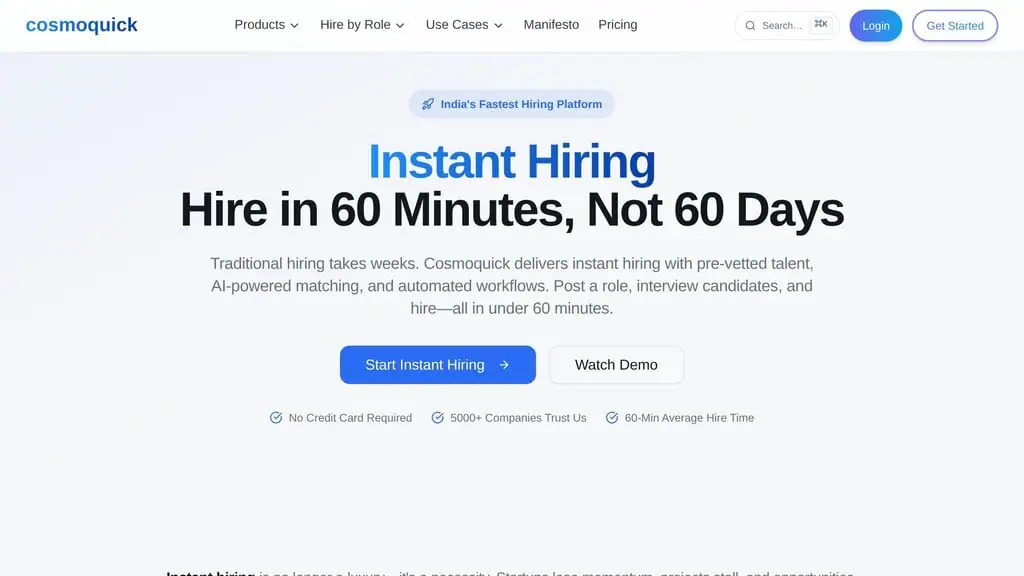
- Post it and start a timer. The claim is live in 60 seconds. Note when the listing actually goes live and when the first application lands.
- Track three numbers, not one. Total applications, applications that meet your hard requirements, and applications you would actually interview. Volume is easy. The third number is the one that decides whether you post again.
- Ask two or three applicants where they saw the role. This tells you whether the community distribution is real or whether everything came through one aggregator.
- Use the free MIRA runs before paying $53. Compare its shortlist against your own read of the same applications. If it agrees with you 80% of the time, it just saved you hours. If it doesn’t, you learned that cheaply.
- Compare against your normal channel. Run one role on CosmoQuick and one through whatever you normally use, in the same week. That comparison is worth more than every stat on their homepage.
Worth testing, not worth committing to yet
The core insight is correct: hiring has fragmented, distribution is the bottleneck, and most job portals still charge premium prices to be a parking spot. Bundling an ATS and AI screening into a $4.99 post is a generous entry offer rather than a bait price with a hidden wall behind it.
What holds me back from a stronger recommendation isn’t the product. It’s the evidence: self-reported reach, pricing that differs across their own pages, and a third-party review base two reviews deep. That combination means “prove it on one role,” not “sign up for a year.” For a founder in India hiring standardized roles, the downside of the ₹99 test is a hundred rupees, and the upside is a distribution channel you did not have before plus an ATS you were probably going to pay for separately. Post one real role, track the three numbers above, and let the results decide.
More verdicts like this are in our library of tested AI tool reviews.
Two claims buyers ask about
Is CosmoQuick legit?
It is a real, operating product with a live platform, published pricing, a public roadmap, a status page and a Microsoft for Startups partnership. It’s also young, and most of its headline statistics are self-reported rather than independently audited.
Can CosmoQuick really hire someone in 60 minutes?
The “60 minutes” claim refers to how fast the platform can surface and schedule matched candidates, not a guarantee that you’ll complete a hire in an hour. Expect a fast first wave of applications and a normal interview timeline after that.
Pricing and company details: see the CosmoQuick profile.
Related Posts

I tested AgainstData on 355 pages of Gmail data. Bulk unsubscribe, personal data deletion requests, pricing, and whether...

AI-Text-Humanizer.com took a 132-word ChatGPT paragraph from 100% AI to 0% on ZeroGPT but flattens your voice. Buy the $...
AIscan24 is a free, no-signup AI detector: it caught pure ChatGPT text at 100% but scored my handwritten paragraph 80%. ...

Honest Aithenticate review after hands-on testing. Does this AI disclosure badge tool meet EU AI Act requirements? Prici...

My hands-on Answer Socrates review covering all features, free plan limits, pricing, and how it compares to AlsoAsked. I...

I’ve spent $4,200 on 118 AppSumo lifetime deals over 5 years. Here’s my honest review: what works, what fails, and wheth...