

Verdict: Buy
Humbot plans, word limits and where to start
| Field | Detail |
|---|---|
| Tool | Humbot |
| Category | AI humanizer bundled with about eleven study and writing tools, running on a proprietary model Humbot calls Humbot 1.0 plus a Gemini-powered rewriter |
| Best use case | Rewriting AI drafts to read more naturally, with adjacent tools in the same subscription |
| Price | Free tier: 200 words a month, 100-word input. One-time $9.99 for 2,000 words. Basic $11.99, Pro $22.99 to $28.99, Unlimited $59.99 to $68.99 and metered at 3,000,000 words. Advanced Words credits sold separately from $5.99. Checked 12 September 2026. |
| Detection bypass | Real but inconsistent, and weakest against Originality.ai |
| Verdict | Buy the $9.99 one-time plan and test it on your own writing before any subscription |
The one-time plan is on Humbot‘s site but not advertised prominently, and it is the closest thing Humbot has to a real trial. The rest of this page is what to check before you pay for more.
Eleven tools under one subscription
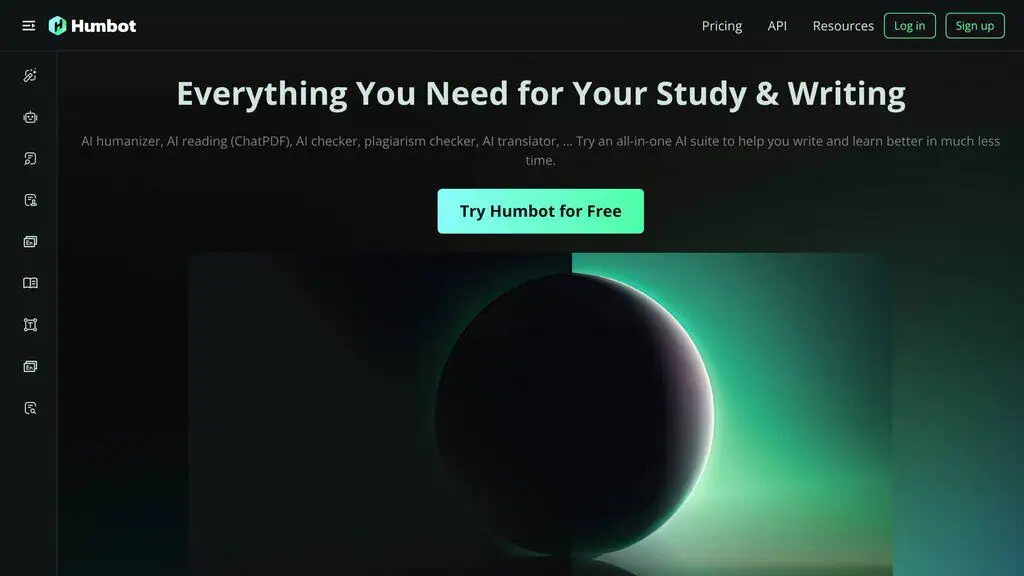
Most AI humanizers do one thing: rewrite your text and hope it passes a detector. When this review first ran, Humbot bundled five tools. There are now roughly eleven, and Humbot has renamed itself an all-in-one AI study and writing assistant to match: the humanizer and an AI checker sit alongside a plagiarism checker, ChatPDF document reading, a translator, a summarizer, an article rewriter, a grammar checker, a citation generator, an AI math solver and a quiz generator.
The humanizer takes content from ChatGPT, Claude, Gemini or any other AI writing tool and rewrites it to reduce AI detection signals. You paste text on the left, pick one of three tone modes (Neutral, Informal or Formal), click Humanize, and get the output on the right with an AI detection check in the same window. There is no learning curve. Where most rivals offer intensity levels (Light, Medium, Heavy), Humbot’s modes change tone: Formal produced the most structured output and suited business content, Informal read more conversational for blogs and social posts, and Neutral split the difference.
The bundle is the stronger argument than the humanizer. If you would otherwise pay separately for a humanizer, a plagiarism checker, a translator and a summarizer, one subscription replaces them. The plagiarism scanner catches duplicate content, ChatPDF lets you question uploaded PDFs and documents, which helps research-heavy writing, and the translator covers 50+ languages; the English-to-Spanish and English-to-French outputs I checked were coherent. Humanization itself works in 50+ languages too, well ahead of competitors that only handle English well or support 10 to 30 languages.
The other differentiator is a developer API, which most consumer humanizers do not offer. It starts at $30/month for 50,000 words, is well documented, and lets agencies and SaaS builders put humanization directly into a content pipeline.
What the humanizer changes, and what Humbot claims for it
Detectors such as GPTZero and Originality.ai score statistical properties, principally perplexity (how predictable each next word is) and burstiness (how much sentence length and complexity vary). A humanizer rewrites to push those numbers toward the human range: varied sentence length and structure, less probable word choices, restructured clauses. It keeps the meaning; it cannot make a shallow argument deep.
Humbot markets a proprietary “Humbot 1.0” model for humanizing AI text, says its article rewriter is Gemini-powered, promises plagiarism-free rewrites, and states on its pricing page that free and paid plans alike produce “totally undetectable AI writing”, which is a stronger claim than the mechanism supports. The Gemini attribution is specific enough to take at face value; “Humbot 1.0” has no model card, parameter count or benchmark behind it, so treat it as branding. Humbot also states that documents are never stored, never shared and never used to train its models, and that it operates under GDPR and CCPA.
Detectors retrain on humanizer output and humanizers retune against new detectors, so any bypass figure, including the ones below, is a snapshot of a loop that moves every few months. A vendor claiming a permanent, guaranteed bypass is describing something the mechanism does not allow. Our guide to how AI detectors work under the hood covers the other side.
Detector scores from the April 2026 run
The original test, in April 2026, was a 500-word article generated with ChatGPT 4o, pushed through Humbot’s Neutral mode, then scored against major detectors. Two caveats: the figures combine published third-party testing with my own checks rather than coming from one controlled run, so the average is an estimate, and detectors retrain continuously, so April figures describe April. I have not re-run the full panel for this update, and I would rather date the old numbers than publish fresh ones I have not measured.
| Detector | Before Humbot | After Humbot | Change |
|---|---|---|---|
| GPTZero | 100% AI | 35-45% AI | Moderate improvement |
| Originality.ai | 100% AI | 55-100% AI | Inconsistent |
| Writer | 25% AI | 13% AI | Good improvement |
| Copyleaks | 100% AI | Variable | Inconsistent |
| Average across 8 detectors | 100% AI | ~76% bypass rate | Decent overall |
The rough 76% average is decent but not industry-leading. Humbot does well against lighter detectors like Writer and basic scanners, and brings GPTZero from 100% down to the 35-45% range. Originality.ai is the weak point: some tests improved significantly, others barely moved. No humanizer I have tested consistently beats Originality.ai, so this is typical of the category rather than an outlier, and the shape of that result has held across every humanizer I have tested.
Why no one can test it against Turnitin
Turnitin is the one most students ask about, and the straight answer is that no humanizer, Humbot included, can give you a reliable guarantee against it. Turnitin exposes no public API or free checker, so no reviewer, this one included, can test against the detector your institution runs; anyone showing you Turnitin bypass scores is inferring them from something else. Its AI detection is bundled with similarity checking against a submissions database that Humbot’s rewriting does nothing about, and institutions see a report you never see, in some configurations including the document’s revision and metadata history.
Humbot can lower an AI-likelihood score, but no tool can make a submission safe in a system you cannot test. Most institutions now have a written AI policy, and using a humanizer to conceal AI authorship generally breaches it whether or not the detector catches it. That is a misconduct risk, not a technology one. Humanizers are uncontroversial for polishing your own writing, adapting a draft for a different audience, and non-academic content where the only question is whether the prose reads well.
Humbot pricing: four prices per plan and a second currency
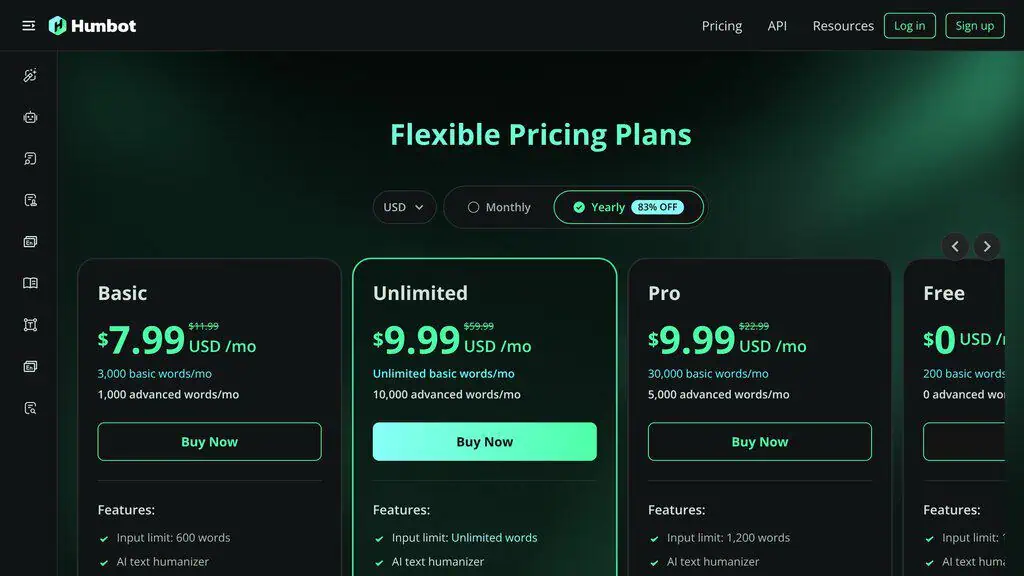
Here is the current pricing, read from the plan data behind Humbot’s pricing page on 12 September 2026 rather than from the marketing copy, because the two do not entirely agree:
| Plan | Monthly Price | Words/Month | Input Limit | Best For |
|---|---|---|---|---|
| Free | $0 | 200 | 100 words | One short paragraph, nothing more |
| One-time | $9.99 once | 2,000 | 600 words | Evaluating it without a subscription |
| Basic | $11.99 | 3,000 | 500 words | Light personal use |
| Pro | $22.99 to $28.99 | 30,000 | 1,200 words | Regular content creators |
| Unlimited | $59.99 to $68.99 | 3,000,000 | 50,000 words | Agencies and heavy users |
The free plan is 200 words, not 600. That is tighter than the 600 words its own marketing once implied, and with a 100-word cap per request it is one short paragraph a month, not enough to judge whether the humanizer works on your writing. The $9.99 one-time plan buys 2,000 words and a 600-word input with no recurring charge.
“Unlimited” is metered. It bills as unlimited and meters at 3,000,000 words a month with a 50,000-word cap per request. For almost every individual that is unlimited in practice, and it is worth knowing before an agency plans a bulk migration around it.
Humbot runs several prices for the same plan at once. Its plan data carries Pro at $22.99, $24.49, $25.99 and $28.99 simultaneously, and Unlimited at $59.99, $62.99, $65.99 and $68.99, with the annual variants spread wider still. This is ordinary price testing rather than anything underhanded, but the figure you are quoted depends on which bucket you land in, and a price you read in any review, including this one, may not be the price you see. Check your own checkout screen.
There is also a second currency. Advanced Words are credit packs sold on top of a plan, at $5.99 for 5,000, $9.99 for 10,000, $14.99 for 20,000 and $19.99 for 50,000. Your plan’s allowance covers the standard humanizer; the advanced tier is billed separately, so budget for both if you intend to lean on it.
| Plan | Monthly Price | Words/Month |
|---|---|---|
| Starter | $30 | 50,000 |
| Growth | $99 | 200,000 |
| Scale | $299 | 1,000,000 |
| Enterprise | $1,999 | 10,000,000 |
That is the developer API. On value, Basic at $11.99 for 3,000 words works out to roughly $4 per 1,000 words, which is expensive, and some alternatives offer 10,000+ words at similar or lower prices. Pro at $22.99 for 30,000 words is about $0.77 per 1,000, ten times the words for roughly twice the price, and the API’s $30 for 50,000 is $0.60 per 1,000. Skip Basic, start on Pro, and move to Unlimited only if you consistently process more than 30,000 words a month and use the bundled tools, where the combined value beats paying for them separately.
Where Humbot lets you down
- The same text scores differently on different runs. Two passes of similar content can produce meaningfully different detection scores: one run passed GPTZero cleanly while another run of similar text was flagged at 45%. For casual content marketing you review and re-run; for anything that needs a predictable result, plan a manual review pass after every humanization.
- Originality.ai is where it fails most. After-scores ranged from 55% to 100% AI in the April run, so on the strictest detector you cannot count on a pass at all.
- The entry plan is poor value. At $11.99 for 3,000 words, a budget user who only needs basic humanization gets more words for less money elsewhere.
- The three modes are less different than they sound. In several tests I had to read carefully to spot the distinctions.
- The marketing overclaims. “Totally undetectable” on the pricing page is contradicted by Humbot’s own inconsistent scores.
Cheaper, freer or single-purpose alternatives
Every tool in this category shares Humbot’s ceiling: detection systems retrain, so no humanizer holds a stable lead. Compare on free allowance and cost per 1,000 words rather than bypass claims, because the bypass claims age fastest.
- For a real free version, which is Humbot’s weakest point: Humanize.io and AI-Text-Humanizer.com both give you more room to test before paying.
- If you only need the humanizer and will never touch the plagiarism checker, ChatPDF or the translator, a single-purpose tool is the cleaner buy, since the bundle is most of Humbot’s argument.
- If you are checking rather than humanizing, our roundup of 25 AI detection tools ranks the detectors by real usage.
Developers and bundle users, not students or bargain hunters
Humbot suits developers and SaaS builders who need programmatic humanization through a documented API; freelancers and small agencies who currently pay separately for humanization, plagiarism checking and translation; multilingual creators working across its 50+ languages; and anyone processing enough volume for Pro or Unlimited economics to work.
Humbot does not suit anyone who needs a guaranteed result against Originality.ai or Turnitin, students hoping to disguise AI authorship, budget users who only need basic humanization, or casual users who humanize a few hundred words occasionally and would be stuck on the 200-word free tier.
Verdict: buy it for the API or the bundle, not the humanizer alone
The verdict depends on the plan and on what you will use. The humanizer on its own is not best-in-class for detection bypass, and on the $11.99 Basic plan the per-word cost is too high against cheaper rivals that perform similarly, so if that is all you want, wait. If you need API access, buy: it is well priced, well documented, and fills a gap most consumer humanizers leave open. If you will use the humanizer alongside the plagiarism checker, translator, summarizer and ChatPDF on Pro or Unlimited, buy, because evaluated as a bundle for freelancers and agencies running multilingual workflows the value is stronger than the humanizer alone suggests. In every case, spend $9.99 on the one-time plan first and run your own writing through it.
Pricing and company details: see the Humbot profile.
Related Posts

I tested AgainstData on 355 pages of Gmail data. Bulk unsubscribe, personal data deletion requests, pricing, and whether...
AI-Text-Humanizer.com took a 132-word ChatGPT paragraph from 100% AI to 0% on ZeroGPT but flattens your voice. Buy the $...
AIscan24 is a free, no-signup AI detector: it caught pure ChatGPT text at 100% but scored my handwritten paragraph 80%. ...
Honest Aithenticate review after hands-on testing. Does this AI disclosure badge tool meet EU AI Act requirements? Prici...

My hands-on Answer Socrates review covering all features, free plan limits, pricing, and how it compares to AlsoAsked. I...

I’ve spent $4,200 on 118 AppSumo lifetime deals over 5 years. Here’s my honest review: what works, what fails, and wheth...